
For decades, individual Africans and groups have called for reparations to be paid to the continent and its varied diaspora by the former European slaving nations for the enormous harm they did to Africa and its people over the 400 years of transatlantic slavery. Now the African Union has taken up the mantle. It has nominated Ghana to lead the continental efforts for reparations, and is joining with the more developed movement among the Caribbean countries. In this wide-ranging cover story, Baffour Ankomah looks back at slavery and the harm it caused to Africa, the history of African efforts towards achieving reparative justice, and how the destructive legacy of Arab slavery in East Africa has been overlooked. He reports that the calls for reparations have advanced to proposals for concrete action.
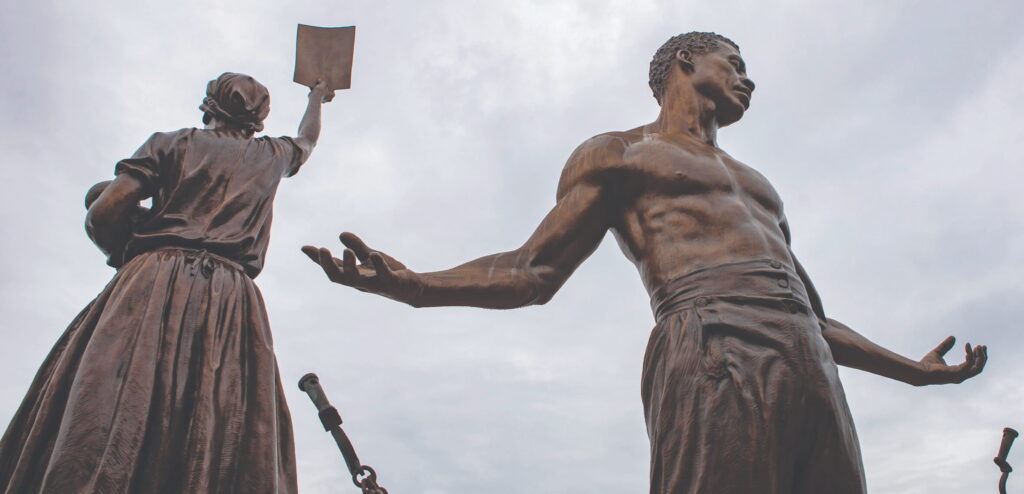
Momentum has been quietly building in Africa to seek reparations for one of the worst crimes ever committed by man against man, the 400-year transatlantic slave trade. The African Union has made that a priority over the last three years, and is working with CARICOM, the Caribbean Community. As that trade brought untold wealth to Europe, they believe the nations that perpetrated it should pay a price, compensating Africa and the people of African descent in the diaspora for the incredible damage slavery did to the continent and its people.
UNESCO, the United Nations Educational Scientific and Cultural Organization, estimates that 12 to 20 million Africans were shipped to the Western Hemisphere as slaves between the 15th and 19th centuries, with about 20% dying on the brutal transatlantic voyage known as the Middle Passage. Millions more were killed as the slave hunters pillaged their way across Africa’s interior and encouraged inter-tribal wars to acquire more slaves, or died on the march to the coast or while waiting for the European ships to arrive at West African ports.
That also depopulated the continent and stunted its growth. A related issue is the Arab slave trade, which began as far back as the year 700 and continued until the early 20th century.
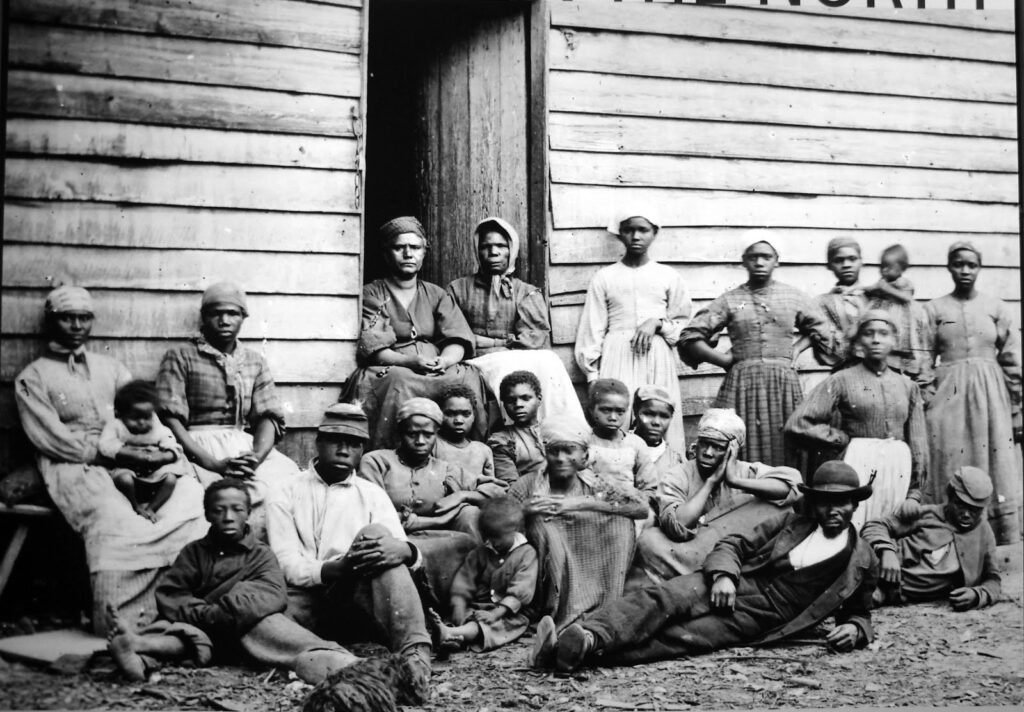
Those who survived the Middle Passage “ended up toiling on plantations under inhumane conditions in the Americas, mostly in Brazil and the Caribbean, while European settlers and others profited from their labor,” Amelia Gentleman wrote in the British Guardian newspaper in November 2023.
About 40% of those taken from Africa’s Atlantic coast were sent to the British, French, Spanish, Dutch, and Danish colonies in the Caribbean Sea. Most of the others went to Brazil, then a Portuguese colony, and to the southern United States, both before and after independence.
“Capitalism and black slavery were intertwined. The Atlantic economy, in every aspect, was effectively sustained by African enslavement,” CARICOM’s ambassador to the United Nations, A. Missouri Sherman-Peter, wrote in 2022.
A UN report released in September 2023 called on the ex-slaving nations to consider making financial payments among other forms of compensation. Bizarrely, however, it cautioned that “legal claims are complicated because of the time passed and the difficulty in identifying perpetrators and victims.”
But many Africans at home and in the diaspora have questioned how difficult it is to “identify the perpetrators and victims” when Africa is still Africa and everyone knows the perpetrators to be the European and American nations that profited from the transatlantic slave trade. Across the Sahara, it was the Arabs who inflicted the pain on the African slaves and benefited from their toil.
Now is the time, the Africans are saying, for the former European and Arab slaving nations to pay up for the grave crimes they committed against Africa and its people – much as other European nations, particularly the former West Germany, paid reparations to Jewish individuals and the nation of Israel for the extermination of an estimated 6 million Jews by Adolf Hitler’s Nazis during World War II.
The beauty of the current movement is that the 55-member African Union (AU) is joining its efforts with those of the 20- nation CARICOM. CARICOM has been leading the Caribbean efforts for reparations over the last few decades, but with Africa now on board, the united continental and diaspora communities have become a force that the former slave nations cannot easily brush aside.
Ghana in charge
The AU has appointed Ghanaian President John Dramani Mahama to lead its campaign as “Champion for Reparations.” Mahama’s predecessor, Nana Akufo-Addo, first approached the AU in 2022 to lend its weight to the reparations movement.
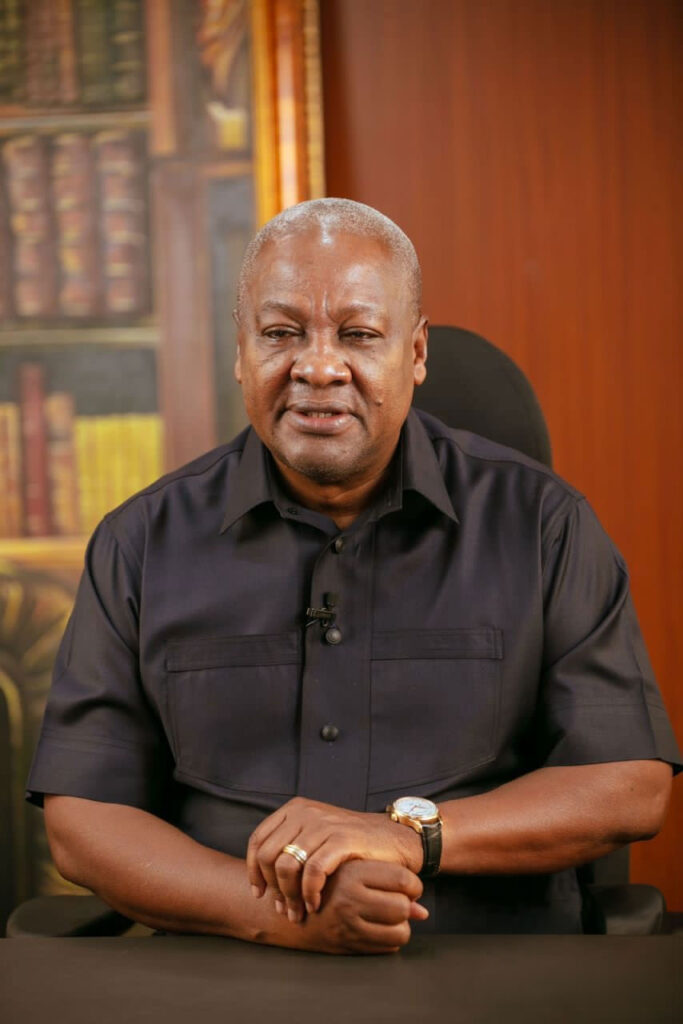
On Oct. 21, Mahama appointed veteran Ghanaian diplomat Dr. Ekwow Spio-Garbrah as his special envoy for reparations, to coordinate the day-to-day affairs of the campaign.
Dr. Spio-Garbrah formerly served as Ghana’s ambassador to the U.S. and Mexico, along with holding posts as the country’s minister of education and of trade and industry, and a senior position at the African Development Bank.
He “is expected to leverage his extensive international network and diplomatic expertise to coordinate with African governments, the AU, CARICOM, and global advocacy groups to advance Africa’s case for reparations,” the president said as he announced the appointment.
“Africa’s call for reparative justice is no longer a whisper – it is a unified demand grounded in historical truth, moral clarity, and our unwavering commitment to dignity,” Mahama said in July 2025, during the AU’s mid-year review of its efforts at a summit in Malabo, Equatorial Guinea. The AU extended its year for “Justice for Africans and People of African Descent through Reparations” by 10 years, from 2026 to 2036.
Slavery, Mahama said, also had devastating aftereffects on Africa and the diaspora, as it was followed by colonialism, apartheid, genocide, and neo-colonial exploitation, resulting in racial prejudices, economic disparities, systemic discrimination, and social inequality.
Addressing these challenges thus requires more than just acknowledging them, he added. “It demands action. We must continue to advocate for stronger legal and institutional mechanisms at the national, regional, and international levels to ensure that justice for the historical trauma inflicted on global Africa is not just a conversation but a reality.”
He said the AU Executive Council’s decision to extend its “Justice for Africans” theme until 2036 would give Africa “the opportunity to sustain the momentum for the realization of this noble cause, as well as map out well-thought-out strategies to mobilize adequate resources to champion the implementation of the theme domestically.
“More than twelve and a half million Africans were forcibly taken against their will and transported to create wealth for the powerful Western nations,” Mahama told the UN General Assembly on Sept. 26, arguing that the slave trade should be recognized as the greatest crime against humanity in history. “We must demand reparations for the enslavement of our people and the colonization of our land that resulted in the theft of natural resources, as well as the looting of artifacts and other items of cultural heritage that have yet to be returned in total.”
The Abuja and Durban conferences
The AU’s current appetite for slavery reparations was induced in 2022, when then Ghanaian President Akufo-Addo asked it to lend its weight to the then- flagging reparations efforts started by individuals and groups from across the continent.
That led to the AU and Ghana holding two conferences on reparations in Accra. The first, in August 2022, was more exploratory, while the second, in November 2023, put more flesh on the bones. President Akufo-Addo followed it up with a presidential retreat on reparations at the end of January 2024.
The first African reparations conference was held in Abuja, Nigeria, in April 1993. It was followed by the United Nations World Conference Against Racism, Racial Discrimination, Xenophobia and Related Intolerance, held in Durban, South Africa, in 2001.
Unfortunately, the 1993 Abuja conference did not come to much because Chief M.K.O. Abiola, its main organizer, was jailed by Nigeria’s then-military government, and he died in custody in mysterious circumstances in July 1998.
In contrast, the UN’s Durban conference, which ended Sept. 7, 2001, gained much global acceptance of slavery reparations in principle, especially by the European nations and the U.S. But those gains were wiped out a mere four days later, by unprecedented terrorist attacks by al-Qaeda in New York City and Washington, which killed more than 3,000 people.
In the days and years that followed, the Americans and the Europeans ignored the commitments they had made in Durban. Since then, they have gone back to their entrenched positions of not agreeing to pay reparations for the crimes committed during the transatlantic slave trade.
The Arab slave trade
The reparations movement, on the other hand, has largely ignored the Arab slave trade in Africa.
Many conscious Africans find it greatly disturbing that both the African and the Caribbean nations (and the diaspora generally) have so far not raised any issues about the Arab slave trade, which lasted for some 1,300 years. One reason for that, some say, is that the movement fears it will distract from the case for reparations against the Europeans and the Americans.
The Arab slave trade began during the Islamic conquest of North Africa, between 647 and 709 AD, with demands for “human tribute” from Berber tribes in the Maghreb. It remained at a relatively low level compared with the Atlantic slave trade, but was maintained until well after the colonization of Africa in the 19th century. Ethiopia did not officially outlaw slavery until 1942.
One estimate is that it enslaved 14 million Africans over the centuries, whether forced to trek across the Sahara, taken from Ethiopia, or shipped from ports in what is now Tanzania. The 19th century represented the highest point of the Arabian trade, where more than 1.2 million Africans were sent to Arabia. The historian Paul Lovejoy estimates that 4.1 million Africans were shipped by the Arabs across the Red Sea to the Persian Gulf and India.
The Arab slavers also sometimes sold African captives to European slavers.
Oman was one of the principal slave- receiving countries in the Middle East, and extended its rule to the East African coast. It has been estimated that in the mid-19th century, about one-third of its population were Africans or of African descent. Bagamayo, in what is now Tanzania, became the mainland outlet for the Arab slave trade. It was replaced by Kilwa, an island off the coast, in the 1850s. Most of the enslaved Africans were acquired in what became southeastern Tanzania and the Lake Nyasa area.
It was reported in 1868 that 30,000 slaves a year were arriving at Kilwa, most from the Lake Nyasa region. Two-thirds of them were shipped directly to Zanzibar, then a dependency of Oman, with the remainder sent to ports in Oman or smuggled elsewhere. For every slave arriving at Kilwa, it was estimated that another had died in the course of procurement and transport.
“Throughout the 19th century,” according to Duncan Clarke, author of the 1998 book Slaves and Slavery, “the Omani-Arab rulers of Zanzibar shipped hundreds of thousands of African slaves to work on clove plantations on the island.” That trade, he added, gave Europe and America, after they abolished their own slavery, “a way to highlight the wickedness of the Arab slavers who continued to enslave Africans well into the first decades of the 20th century.”
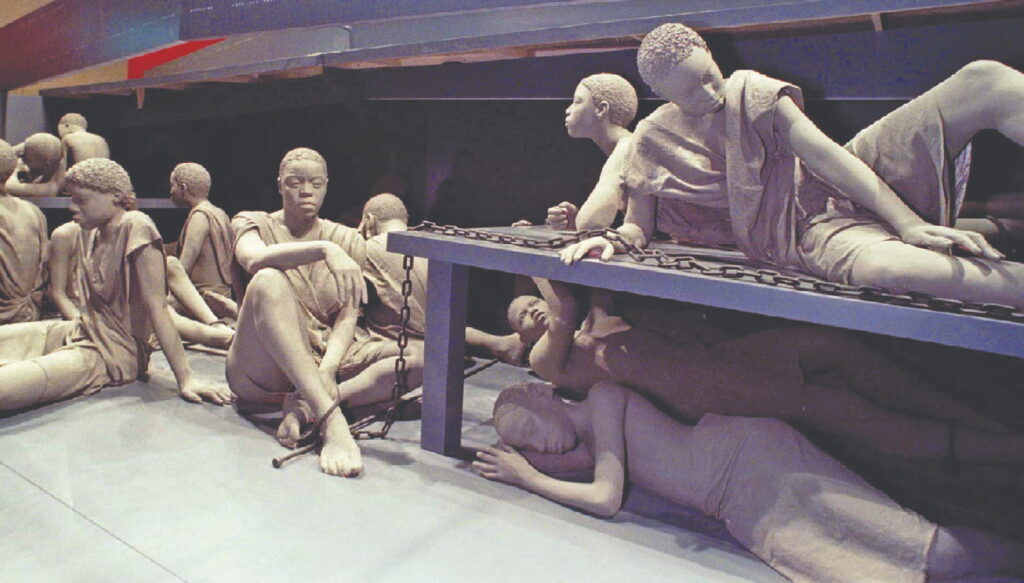
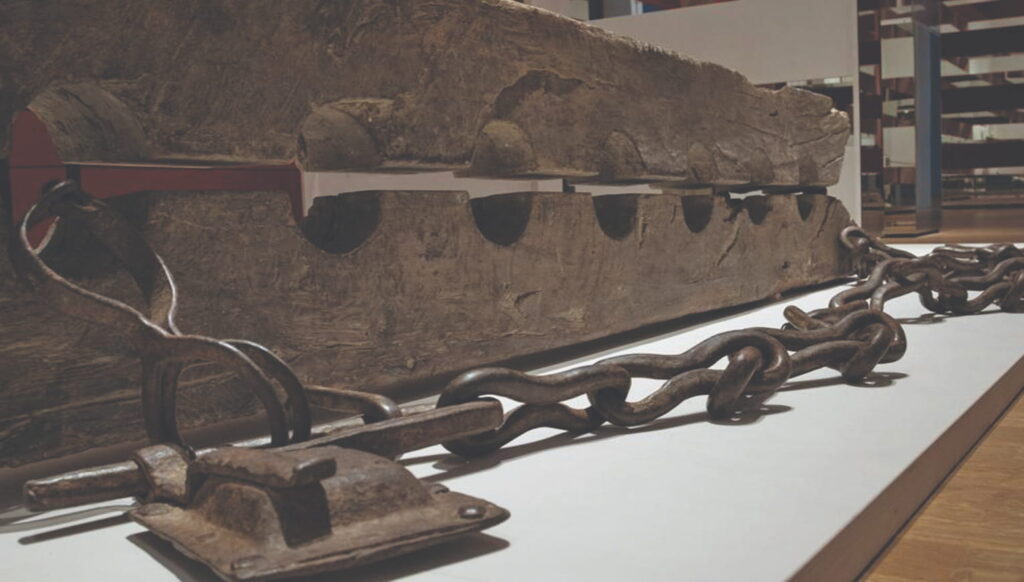
The “Middle Passage” of the Arab trade often involved a trudge across the Sahara, in leg and neck chains, or with their necks held in large forked sticks and their hands tied with bark thongs.
“The hardships of these long marches across the desert were considerable,” Duncan Clarke wrote, “and much later travelers reported that the routes were lined with the parched skeletons of those who succumbed to exhaustion and thirst along the way.”
There “was a steady demand for slaves throughout the Islamic world, which had to be met from wars, raids, or purchases along the borders with non-Islamic regions,” Clarke says. “Although some of these slaves came from Russia, the Balkans, and central Asia, the continuing expansion of Islamic regimes in sub-Saharan Africa made black Africans the major source.”
It is often believed that when slavery in the Black Sea area dried up, it triggered greater demand for Ethiopian “red” slaves, in particular the Galla and Oromo peoples, who were prized for their women’s beauty.
Unlike the transatlantic slave trade, in which most of the people sent to the Americas were male, the Arab slave trade preferred girls and young women. According to one historian, “while in the European ‘New World’ in the Americas the measure of a man’s stature was mapped out and calibrated on the physical dimensions of empire built upon the sinews of forced masculine labor, in the Islamic Orient wealth was a reflection of prestige, with females the target of male pride.”
Women slaves in the Arab world were often turned into concubines living in harems, but rarely became wives. But the offspring of the union between an Islamic master and a female slave was born free, out of respect for the child’s Muslim paternity. In contrast, any offspring of the slave trade in the Americas was born into slavery.
There are few visible traces of the descendants of the African slaves in the Arab world today, however – although a 1994 BBC documentary found that racial discrimination against the descendants of African slaves in Pakistan was so bad that one person recounted on camera how, even in sports, they were not picked to represent the country at national and international levels, no matter how good they were.
However, in contrast with the trans-atlantic trade, one historian has attested, the high proportion of females taken by the Arab slave trade “caused far greater demographic damage to Africa and consequently greater economic decline, with its excessive poaching of the reproductive potential of the harvested areas.”
The Arab nations should not be let off the hook, urges one reparations advocate in Accra: They should pay reparations to Africa and people of African descent as much as the Europeans who plied their trade on the west coast.
Trauma and depopulation
One very important issue is the impact of slavery on those left behind in Africa. Imagine the horror and terror and the psychological trauma that the kidnapping or seizure of your father, mother, sister, brother, aunt, cousin, uncle, daughter, son, neighbor, friend while working on the farm – or walking in the Gambian forest looking for wood to make a drum, like Kunta Kinte, Roots author Alex Haley’s Mandinka ancestor – and forced into slavery abroad, and the knowledge that you will never see them again, do to your state of mind, your sense of justice and security, your worldview, your future, your very idea of survival.
For centuries, the African people were terrorized by the Europeans on its west coast, the Arabs in the east, and the African minions who collaborated with them. Africa became a human-production factory. Its whole social and economic organization was undermined and eventually seriously curtailed.
“The process by which captives were obtained on African soil was not trade at all,” Dr. Walter Rodney, the Guyanese scholar and historian, wrote in his book How Europe Underdeveloped Africa. “It was through warfare, trickery, banditry, and kidnapping. When one tries to measure the effect of European slave trading on the African continent, it is essential to realize that one is measuring the effect of social violence rather than trade in any normal sense of the word.”
The depopulation that both the European and Arab slavery engendered was massive. Dr. Rodney quotes one European scholar as having given the following estimates of the world population between 1650 and 1900:
In 1650, Africa’s population stood at 100 million, Europe’s was 103 million, and Asia’s was 253 million.
In 1750, Africa’s population was still 100 million, but Europe’s had grown to 144 million, and Asia’s stood at 437 million.
In 1850, Africa’s population was still at 100 million, but Europe’s had jumped to 274 million, and Asia’s had risen to 656 million.
In 1900, after the abolition of slavery in the U.S. and Brazil, the continent’s population had gone up to 120 million, while Europe’s had leapt to 423 million and Asia’s to 857 million.
The math is simple. In 1650, Europe had only 3 million more people than Africa. By 1900, it had more than three times as many, a gap of 303 million people.
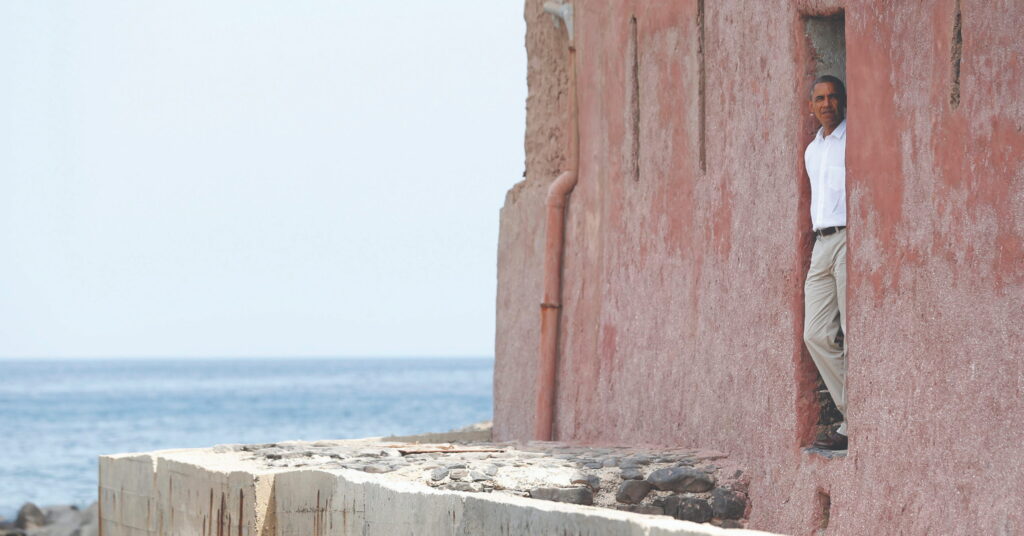
In theory, all other things being equal, Africa’s population should have grown at the same or a similar rate as Europe’s. So with Europe’s population having grown by 323 million in 250 years, Africa’s should have similarly grown by at least 300 million. But this was not the case, because of slavery. Africa’s population grew by a mere 20 million.
Therefore, Africa arguably lost 280 million people in those 250 years because of both numbers directly taken as slaves and the damage that slavery dealt to the African notions of well-being, kinship, death and dying, values and psyche. This is the depth of the issue confronting the new advocates for slavery reparations in Africa.
Intensifying the movement
Remarkably, all these deep discussions about the impact of slavery on the African people had been largely put on the back burner until Ghana pushed the AU in 2022 to be more active in the reparations debate.
“No amount of money will ever make up for the horrors,” Akufo-Addo said in a speech to the UN General Assembly in September 2023, “but it would make the point that evil was perpetrated, that millions of productive Africans were snatched from the embrace of our continent, and put to work in the Americas and the Caribbean without compensation for their labor.”
He said that Africans “do not seek to shirk any responsibility for the problems we face that are of our own making,” but that it was impossible to “pretend that the present-day economic and social conditions of Africa have nothing to do with the historical injustices that have fashioned the structures of the world. Granted that current generations are not the ones that engaged in the slave trade, but that grand inhuman enterprise was state-sponsored and deliberate, and its benefits are clearly interwoven with the present-day economic architecture of the nations that designed and executed it.”
The Accra Reparations Conference in November 2023 was an important landmark, as its theme “Building a united front to advance the cause of justice and the payment of reparations to Africans,” radically moved the agenda further than the August 2022 conference’s theme of “Advancing justice: reparations and racial healing.”
In attendance were heads of state and dignitaries from Ghana, Africa, and the Caribbean; intergovernmental organizations such as the UN, AU, and CARICOM, and academics, policymakers, activists, and civil-society actors from across Africa, the U.S., Europe, the Caribbean, and the UK.
Akufo-Addo told the conference that “the call for reparations was not a plea for alms but a call for justice.” He said that if Germany and other countries, firms, and institutions could rightfully pay reparations to the descendants of the Jewish victims of the Nazis, “then it is only just and fair that the same is paid to the descendants of the victims of the transatlantic and Arab slave trade. It has been 400 years and we want to bring closure to this tragedy.
“Predictably, the question of reparations only becomes a subject of debate when it comes to Africa and Africans. When the British ended slavery, all the owners of the enslaved Africans received reparations to the tune of some £20 million, the equivalent today of some £20 billion, but the enslaved Africans themselves did not receive a penny. Likewise, in the U.S., owners of slaves received $300 for every slave they owned, but the slaves themselves received nothing.”
Payments to slaveowners show guilt
The payments made by Britain to the slave owners after it enacted a law abolishing slavery in 1833 has now become a cantankerous issue facing the country whose empire once covered one-fourth of the world. The British government did not have the money at the time to pay compensation, so it borrowed £20 million from the Rothschild banking family.
One of the beneficiaries was the Church of England (also known as the Anglican Church). In place of the 411 African slaves on its two plantations in Barbados (Codrington and Consett), the Church received £8,823 in compensation. The Bishop of Exeter received around £12,700 for having to free his 655 African slaves.
In November 2023, the insurance giant Lloyd’s of London promised to invest £52 million (about US$68.3 million) to promote racial equality, in recognition of its “significant role” in the transatlantic slave trade.
Lloyd’s had given in, after decades of resisting responsibility and even defending itself in court against paying reparations, in June 2020, when an independent review by Johns Hopkins University in Baltimore, Maryland, found the insurance market was part of “a sophisticated network of financial interests and activities” that made trans-atlantic slavery possible.
Another 2020 “confessor” was the British brewery and pub chain Greene King, established in 1799. Its founder, Benjamin Greene, owned sugar plantations in the Caribbean, where he used African slaves to create his wealth.
The company now operates more than 2,500 pubs, restaurants, and hotels in Britain, all built on the money that came from the slave-worked plantations in the Caribbean. In 1833, after the Slavery Abolition Act, Benjamin Greene received compensation for having owned 225 African slaves. It was another 187 years before Greene King apologized.
In February 2023, the Trevelyan family, who once owned as many as 1,000 African slaves on its plantations in Grenada, and was given £34,000 in compensation after slavery was abolished, made a public apology for its links with slavery. The family pledged a £100,000 fund to investigate the lingering economic impacts of slavery in the eastern Caribbean, as well as establishing a reparations research fund at the University of the West Indies.
Other British entities that have come clean on their slave past includes the Scott Trust, which owns the Guardian and the Observer newspapers. It apologized in March 2023 for the role the Guardian’s founders had in transatlantic slavery: John Edward Taylor, the journalist and cotton merchant who founded the Manchester Guardian in 1821, and at least nine of his 11 shareholders.
In 2022, the Bank of England (the central bank) apologized for having owned 599 African slaves on two plantations in Grenada in the 1770s.
In September 2020, Britain’s National Trust, the conservation charity that looks after the country’s historic sites, coastlines, countryside, and green spaces, confessed that up to one-third of its properties had links to colonialism or slavery, with 29 properties connected to successful claims for compensation after abolition.
The Royal Bank of Scotland and Barclays Bank have similarly admitted their links to transatlantic slavery.
In 2019, Glasgow University in Scotland became the first British university to admit its slavery past and set up a restorative- justice scheme, setting aside £20 million to build a research center in partnership with the University of the West Indies, for the study of public health and economic growth in the Caribbean.
Cambridge University followed suit in September 2022, promising to fund further research and engagement with Black British communities and universities in West Africa and the Caribbean.
Oxford University, however, has not issued a single, comprehensive apology for its slavery past to date, although some of its individual colleges and departments have. Balliol College, one of Oxford’s constituent parts, issued an apology for accepting donations tied to the slave trade between 1600 and 1919, stating it was “sorry that we took those donations.”
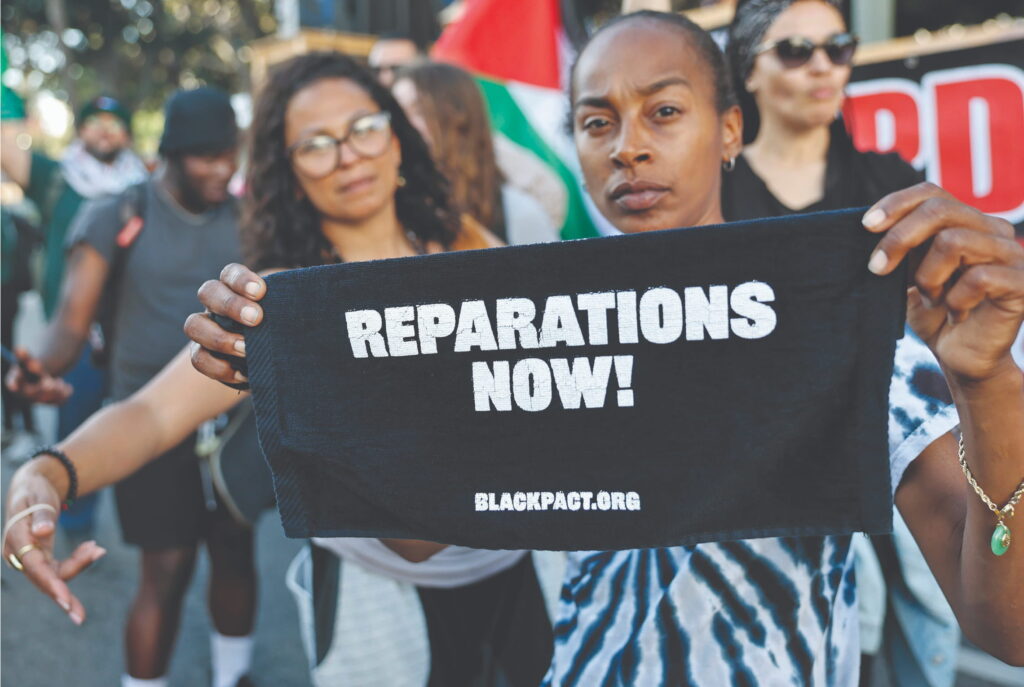
In the U.S., where hundreds of universities have links to slavery, some have come clean in recent years. In 2006, Brown University in Providence, Rhode Island, founded in 1764, did so. In April 2022, Harvard University, founded in 1636 in Cambridge, Massachusetts, followed suit.
The government of the Netherlands apologized for the country’s role in slavery in December 2022, and established a fund of €200 million ($230 million) to raise awareness of its history as a colonial power, as well as “fostering engagement” and “addressing the present-day effects of slavery.”
None of these admissions and confessions have, however, led to a full-blown reparation payment to the descendants of the former slaves.
Parliament admitted guilt in 1806
Yet as far back as 1806, the British Parliament, after vigorous debate, finally accepted liability for the “African Slave Trade” and promised to “atone” for the wrongs it had committed against Africa and its people. Africa and its diaspora, therefore, can hold Britain to its word today, and demand reparations for the huge role the British played. Though a latecomer to the slave trade, Britain became number one in it.
Evidence discovered in 2011 showed that Britain’s two houses of Parliament proclaimed in 1806 that “the African Slave Trade [was] contrary to the principles of justice, humanity, and sound policy,” and that Parliament would “with all practicable expedition take measures to abolish it, in such manner, and at such time, as shall be thought advisable.”
The then Prime Minister, Lord William Wyndham Grenville, told the House of Lords that “there [was] nothing comparable to the evil of the African Slave Trade to be found in the whole history of this world, ancient or modern.”
By whom is it continued? he asked. “By us who call ourselves the most civilized,” he answered. “I would ask the advocates of this Traffick, in what book, human or divine, am I to read, in what principle of ethics am I to find, or by what rule of reasoning can I say, that you, the inhabitants of the island of Great Britain, are born with a right to buy and sell the flesh and blood of human beings?”
This is the evidence to nail Britain to its reparations cross today, thanks to two yellowing volumes of official parliamentary records on the slave trade, from 1791 and 1806. They were discovered in 2011 on the shelves of Ghana’s National Library in Accra, whose roots go back to the Gold Coast Library Board, established while Britain ruled the Gold Coast, from 1844 to 1957.
The first volume has a long-winded title: Substance of the Debates on a Resolution for Abolishing the Slave Trade which was moved in the House of Commons on the 10th June 1806, and in the House of Lords on the 24th June 1806, with an Appendix, containing Notes and Illustrations. It contains an abridged transcript of debates in both the House of Commons and the House of Lords on the resolution to abolish the slave trade introduced by Britain’s first foreign secretary, Charles James Fox.
The second volume’s title is Abstract of the Evidence delivered before a Select Committee of the House of Commons in the years 1790 and 1791 on the part of the Petitioners for the Abolition of the Slave Trade. It summarizes the evidence given to the committee by both pro- and anti- abolition campaigners.
“In consequence of the numerous petitions which were sent to Parliament from different counties, cities, and towns of Great Britain, in the year 1788, for the abolition of the Slave Trade, it was determined by the House of Commons to hear evidence upon that subject,” Phillips and Fardon, the publishers, explained in the preface. “The slave merchants and planters accordingly brought forward several persons as witnesses, the first [on] behalf of the continuance of [the] Slave Trade, and [the] latter in defense of Colonial Slavery.”
Those witnesses were heard and exa-mined in 1789 and 1790. In 1790 and 1791, several persons were called on the side of the abolitionist “Petitioners of Great Britain” to substantiate the petitions’ evidence, “and to invalidate several points of the evidence which the others had offered.” The abstract was made up from their statements.
“The evidence for Africa and the Middle Passage, on the side of the Petitioners of Great Britain, is given by persons who have been to almost all the conspicuous parts of Africa, from the River Senegal to Angola,” Phillips and Fardon explained. “Many of them have had great opportunities of information, from having been resident on shore, or having been up and down the different rivers, or from having made each of them several voyages.”
It said their information “goes to things at different periods from the year 1754 to 1789.”
MPs stood up in both the House of Commons and the House of Lords and acknowledged the huge guilt of their island nation in what they called the “African slave trade,” and asked their motherland to “atone” for its role.
Today, this is a legal peg on which Africa and its diaspora can hang their demand for reparations from Britain, Europe, America, Canada, and the Arab nations who benefited from the “African slave trade.”
The British Parliament had voted to end the trade in January 1796, but no action was taken to implement that decision.
Thus, when the new debate opened in the House of Commons on June 10, 1806, many MPs appeared to carry some sense of guilt that their hallowed Parliament was turning into a toothless bulldog. So the motion for abolition introduced by Charles James Fox had many friends on the floor of the House.
However, two MPs from Liverpool, one of the cities that received the most benefit from the slave trade, objected to abolishing it. In doing so, they unwittingly exposed the guilt of Britain and its liability for the slave trade, something the modern advocates for reparations can use to further their claims.
MP Isaac Gascoyne told the House of Commons that Liverpool would be “absolutely ruined” by abolition. “I know that if it had not been for that trade, this country would never have been in its present independent situation.”
The second MP from Liverpool, General Banastre Tarleton, went even further. “Whatever may be said about the injustice or the inhumanity of this Trade,” he told the House of Commons, “it is not to be denied that it is a Trade which has been carried on under the auspices of this House, and agreeable to law. I have no difficulty in saying that the prosperity of Liverpool is intimately connected with the African Slave Trade.”
Liverpool, Tarleton continued, “was once a mere fishing hamlet, but it has risen into prosperity in exact proportion to the extent of the African slave trade, so as to become the second place in wealth and population in the British Empire.
He said he had “no doubt that much evil will result to this country” from abolishing the British slave trade, and warned that in Liverpool, “bankruptcies will follow, and that a number of our most loyal, industrious, and useful subjects will emigrate to America.”
Banning the slave trade
Closing the debate, Secretary Fox thundered: “There never was a time in which any other evil existed that was comparable to that of the African Slave Trade. There never was, among human beings, before the institution of the African Slave Trade, anything like the cruelty of seizing multitudes by force, by rapine; supporting that seizure by murder; possessing them by fraud; by false accusation; supporting such accusation by the mockery of justice; and all this for the purpose of carrying on this detestable Traffick; for the purpose of transporting them to a foreign country to slavery for life.”
Fox then hit the nail on the head, at least for the cause of today’s African reparations movement. He quoted “an honorable gentleman” who said that the African Slave Trade was “a Trade carried on under British law, and that it is, to all intents a British Trade.”
“It is a Trade within the jurisdiction and control of the British Parliament,” Fox said. “When the Honorable Gentleman says, ‘you have encouraged this Trade,’ I do not deny the fact: I am bound to admit it. But then, by so much more do I say, it is your duty to atone for it, and to put an end to the mischief which you have thereby occasioned.”
The resolution to abolish the slave trade passed by a 114-15 vote.
Fourteen days later, on June 24, the debate moved to the upper house, the House of Lords. Prime Minister Grenville introduced the motion for abolition.
One source of supply to the slave trade was “the practice of ‘man-stealing,’” he said. “We are the persons who excite and encourage this system of violence and fraud. My Lords, these are the modes by which the Trade is carried on. While you give encouragement to fraud, violence, and cruelty, in Africa, fraud, violence and cruelty will prevail there. The African Slave Trade is founded on the existence of injustice.”
The Bishop of London, Beilby Porteus, noted that Africans were enslaved “first, by kidnapping; next by means of pretended crimes; and, last of all, by the means of the breaking up of villages, and being taken in war.”
The House of Lords voted 41-20 for the resolution, which, when it was passed into law, became the Abolition of the Slave Trade Act of 1807.
In effect, Great Britain’s own Parliament decided that it, as a nation, it was guilty of sanctioning and encouraging the African slave trade. That makes a prima facie case for “atoning” for the crimes of the trans-atlantic slave trade through reparations.
Today’s reparations movement
In 1999, an organization calling itself the African World Reparations and Repatriation Truth Commission met in Accra, and demanded $777 trillion in compensation for the crimes committed against Africa and its people during the slave trade and colonial periods. That astronomical figure was merely a metaphorical sum meant to draw attention to the enormity of the crime that slavery and colonialism represented.
Over the years, the sheer quantum of the offense and the corresponding size of the anticipated atonement have frightened the former slavers into resorting to sophistry to deflect the blame onto the Africans – by claiming that it was Africans who sold the slaves to traders, and therefore their descendants are not entitled to reparations.
In 2014, the Caribbean countries, under the auspices of CARICOM, set up a Reparations Committee which put forward a 13-point reparations plan. CARICOM met with organizations in the U.S. and South America; contacted those European governments which had historic involvement in the slave trade; and sent its 13 demands to the European Union Parliament.
Among those demands were a formal apology from European governments; a repatriation program for people of African descent in the Caribbean wishing to return to Africa; European investment in Caribbean public health and literacy programs; and debt cancellation. But Britain, France, the Netherlands, Spain, Portugal, and the other former colonial powers rejected the plan.
In October 2019, David Comissiong, Barbados’s ambassador to CARICOM, addressed the West and Central Africa Conference on the United Nations Inter- national Decade for People of African Descent, and emphasized that the total payment to the slave owners in the Caribbean by Britain when it abolished slavery was the equivalent of £178.6 billion (about US$234.7 billion) in today’s values. That, he said, “is an indication of what is at stake in the modern demand for reparations.”
“At the heart of the demands for reparations is the understanding that the past cannot be erased, and must not be ignored,” Professor Olivette Otele of London University’s School of Oriental and African Studies wrote in the Guardian in March 2023. “Without understanding the history of slavery and colonialism, we cannot understand the extent to which societies today are shaped by systemic racism, unfair distribution of assets, inequality, and violence – and how all of these have led to despair, marginalization, and disenfranchisement in parts of the population.
“We will also hear loud objections, from those who benefit from the status quo or who cannot imagine a different world,” she continued. “But it is only through confronting the past that we can reimagine our future – and it is only through reparations that this new future can take shape.”