
Nnamdi Kanu, the founder of the Indigenous People of Biafra, was sentenced to life in prison on terrorism charges last November. His movement’s advocacy for the Igbo people, a prominent ethnic group in Nigeria’s southeast, to establish an independent Biafran state initially began without violence, but escalated as the Nigerian government responded with significant force. The region has a history of secessionist movements. In 1967, when the Igbos attempted to create an independent nation called the Republic of Biafra, it was met with violent suppression during a civil war that lasted three years and resulted in over a million fatalities. Kanu’s sentencing has ignited discussions within the country, with some supporters claiming his campaign originates from deep-seated political and economic grievances of the Igbo community, while critics argue against his methods, accusing him of inciting violence to further his agenda. Promise Eze reports.
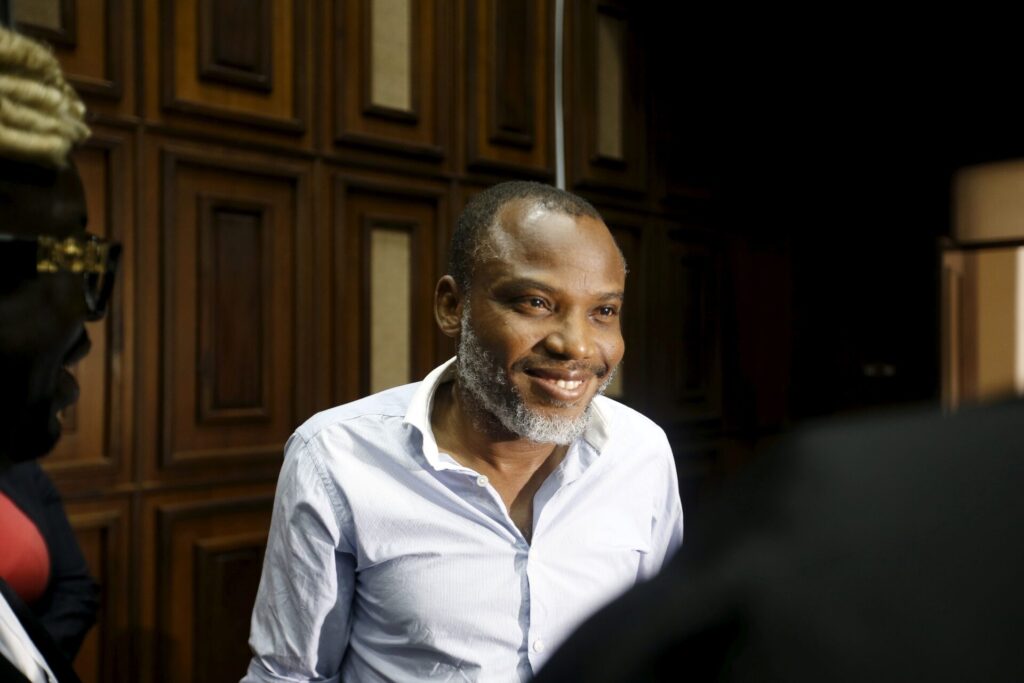
On Nov. 20, 2025, a Nigerian court in Abuja sentenced separatist leader Nnamdi Kanu to life imprisonment after finding him guilty of terrorism and several related offenses, bringing an end to a decade-long legal battle.
Kanu, founder of the proscribed Indigenous People of Biafra (IPOB), led the call for an independent Biafran state in Nigeria’s southeast, a demand that violates the Nigerian constitution. The group has also been accused of orchestrating deadly attacks on security personnel and civilians.
Kanu was first arrested in 2015. He was granted bail, but fled after a deadly raid on his home in 2017. In 2021, he was apprehended in Kenya and extradited back to Nigeria.
Prosecutors had sought the death penalty, but the presiding judge rejected the request, noting that capital punishment is increasingly “frowned upon.”
Throughout the trial, Kanu insisted he was innocent and challenged the court’s jurisdiction. He had earlier dismissed his legal team and later refused to defend himself. He was absent during the verdict after being removed for disruptive behavior.
The quest for Biafra
Kanu’s sentencing has sparked debate in Nigeria. Some of his supporters have called for his release or amnesty, arguing that his campaign stems from longstanding political and economic grievances among the Igbo people, a major ethnic group concentrated in the country’s southeast.
Others suggest that his life sentence reflects ethnic bias, noting that militants from other regions have sometimes received lighter sentences or amnesty.
Kanu’s messages through his online radio broadcasts resonated with many Igbos, whose 1967 attempt to establish an independent nation – the Republic of Biafra – was violently suppressed in a three-year civil war that killed more than a million people.
Since then, many Igbos have continued to feel politically and economically sidelined. Infrastructure development in the region has lagged, federal funding has been limited, and no Igbo has held Nigeria’s presidency or vice presidency since the country returned to democracy in 1999.
Critics, however, fault Kanu’s tactics, accusing him of promoting violence to advance his message and targeting those who do not align with IPOB’s ideology.
But several analysts said that IPOB, founded in 2012, initially adopted peaceful methods such as rallying supporters, organizing protests, and calling for election boycotts. It only became violent, they said, following a bloody crackdown on the group from the Nigerian government, which had failed to address the group’s concerns and viewed Kanu’s growing influence as a threat.
According to Amnesty International, more than 150 Biafra supporters were extrajudicially killed in 2015 and 2016. Many others who were arrested are still missing. The crackdown forced IPOB to adopt a more confrontational approach. In 2015, Kanu began calling for armed struggle, using incendiary broadcasts to spread hate and disinformation.
In 2020, Kanu launched a militia, the Eastern Security Network, claiming it would protect southeasterners from attacks by herders and jihadists. However, the group quickly became embroiled in violent clashes with Nigerian security forces and began targeting civilians to assert its dominance in the region.
In February 2021, IPOB announced that the second Biafra war had begun.
The resulting violence devastated the southeastern economy. Between 2020 and 2021, more than 160 police facilities were destroyed, and 175 officers were killed. Amnesty International reports that at least 1,840 people were killed in Nigeria’s southeast between 2021 and 2023.
Chinedu Obiora, 28, is still haunted by the disappearance of his father, a traditional leader taken during a raid on their family compound in Orsu, in Imo state, in November 2022. Armed secessionist fighters stormed the compound before dawn, firing into the air as they dragged away his father, who had been outspoken against the violence in the region.
“We watched from our windows, too terrified to do anything. Within minutes, they had taken my father, and we haven’t heard from him since,” Obiora recalled, describing how militants have established a parallel government in rural areas, maintaining control through fear and violence.
“My father wasn’t the only victim. Some villagers were beheaded, with their bodies left in the market square. It’s a brutal reality. Some of these attackers invade homes, rape women in front of their families, and then shoot the men,” he said.
Dengiyefa Angalapu, a research analyst at the Center for Democracy and Development in Abuja, argues that while some view Kanu’s sentencing as a major blow to the Biafra agitation and a setback for armed groups, ignoring the deeper issues driving the separatist movements risks paving the way for new leaders and factions to emerge.
He noted that pro-Biafran movements existed long before IPOB did. Heavy-handed government crackdowns, he warned, may temporarily suppress a group, but they rarely resolve the underlying grievances, often leading to the rise of new movements.
“If you sentence Nnamdi Kanu to life imprisonment, another Nnamdi Kanu will inevitably emerge, because the grievances that gave rise to him remain potent and unresolved,” Angalapu said. “For me, sentencing him to life imprisonment will not end the agitation; addressing the root causes of the conflict is what will truly make a difference.
“The question we should be asking ourselves is why Nnamdi Kanu’s message resonates with so many people and how he was able to gather such a large following,” he continued. “If we dig deeper, we find that the messages of marginalization, inequality, and the absence of transitional justice after the Biafra War are still very potent in the Southeast. If these issues are not addressed, it is only a matter of time before another, more dangerous group resurfaces in a different form.”
Boko Haram’s playbook
Angalapu’s view is echoed by many observers who caution that a court ruling alone cannot end the Biafra separatist movement, pointing to the example of Boko Haram. After its founder, Mohammed Yusuf, was killed in police custody in 2009, the group became more extreme under Abubakar Shekau. It adopted a harsher ideology, militarized its operations, and eventually split into even deadlier factions.
Kunle Adebajo, former editor at HumAngle – one of Africa’s leading conflict-reporting platforms – fears that IPOB may be following a similar trajectory. He notes that the group has grown beyond a movement centered on one man, building a structure that now stretches beyond Nigeria’s borders. He worries that even after Kanu’s arrest, new factions have formed, strengthened by diaspora funding used to buy arms.
“IPOB has thousands of loyal members across the world, and I think the only way to really incapacitate the group is for Nigeria to cooperate and work with the governments of the countries where they are strongest,” Adebajo said. “The focus should be on targeting their finances and ensuring that those identified as fueling armed violence in Nigeria face the law in those countries. Otherwise, we will keep seeing cases where the top leader is arrested, sentenced, and imprisoned, only for others to rise and try to take charge, dwelling on the perceived injustice of their idols they believe have been unfairly treated by the government.”
In the southeast, some residents who oppose the Biafra movement hope Kanu’s sentencing will at least lower the morale of secessionist fighters, whose actions have prompted intense military operations across the region. The area is now heavily militarized, and security forces have faced criticism for raiding villages and allegedly torturing or killing Igbo civilians, including those not affiliated with the Biafran cause. The Nigerian armed forces deny these allegations.
Since late 2022, Ifeoma Chinedu from Awomama, Imo state, has been trying to raise funds to rebuild her business after soldiers, seeking revenge for the death of a comrade at the hands of armed separatists just a few meters from her home, set fire to her shop.
“They broke into my compound with an armored tanker,” she recalled. “They accused me of hiding the men who killed the soldier. They threatened to burn down my house. I was pleading with tears, telling them I do not support Biafra. Unknown to me, they had already set fire to my shop outside. I lost millions of naira worth of soft drinks.”
But some still believe that the Biafran dream must become a reality. Ikenga Ebuka, a 30-year-old trader, is one of them. Despite the escalating violence, he believes an independent Biafra is the only way for Igbos to achieve their full potential in Africa.
“Biafra is the only hope for our future,” said Ebuka, who says he seeks justice for those killed during the civil war and for the many young people slain by security forces in the southeast. “I love Nnamdi Kanu, and I am ready to fight for Biafra if the time comes.”