
The African Union has been focusing on improving its effectiveness for the past ten years. It has established a framework that integrates peacekeeping operations with regional economic groups; however, it has faced challenges in intervening to resolve conflicts in areas like the Democratic Republic of Congo, the Sahel, and Sudan. Most interventions in these situations have been carried out by regional coalitions or external nations. Any AU solution will necessitate that individual countries recognize the tangible benefits of collective action, viewing it not merely as a theoretical pan-African ideal but as a strategic investment in stability at the national, regional, and continental levels. Ndubuisi Christian Ani writes.
African Union (AU) reforms to improve the body’s effectiveness started 10 years ago, in 2016. The process involves enhancing the African Peace and Security Architecture (APSA), which includes structures like the Peace and Security Council (PSC) and regional economic communities such as the Economic Community of West African States (ECOWAS). But AU interventions in Sudan, the Democratic Republic of the Congo (DRC), South Sudan, Mozambique, and the Sahel still appear marginal, as external powers reclaim dominance in Africa’s security landscape.
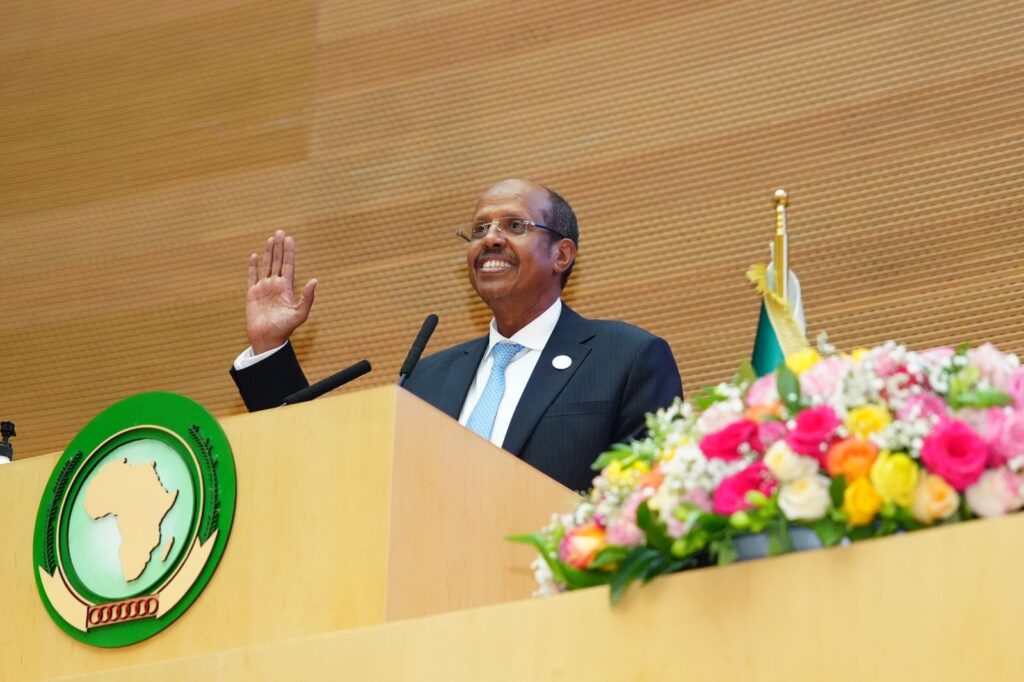
The African Union is currently chaired by Mahamoud Ali Youssouf from Djibouti, who serves as the head of the secretariat, along with Burundian President Évariste Ndayishimiye, who holds the position of ceremonial chairperson of the group.
Has the AU’s reform agenda – with its focus on structures, financing, and modalities – sidelined the more urgent task of sustaining collective African conflict responses grounded in member states’ unity of purpose?
A senior AU official says the core problem is not institutional design or policy frameworks, but rather member states’ insufficient support for African-led initiatives. A 2025 review concluded that the AU had a comprehensive normative architecture for peace, security, and governance, although some frameworks needed clarification.
Yet the same leaders who routinely invoke “African solutions” undermine regional initiatives and seek external conflict mediation, treating African-led interventions as optional or secondary. This lessens the AU’s influence, despite its robust institutional presence.
In its first decade, the AU drove mediation and peace-support operations with member states’ backing. By the time the reform process began in 2016, the continental body’s role in major crises had already started to weaken.
The United Nations took over the missions in Mali in 2013 and in the Central African Republic in 2014. In 2016, the PSC reversed a decision to deploy peacekeepers in Burundi, inadvertently creating a risk aversion among council members toward approving future missions. The joint AU-UN Darfur mission was closed in 2020, leaving only Somalia with an active – albeit donor-dependent – peace support operation.
Regional groups take the lead
From 2013 to 2023, regional economic communities, led several major initiatives, particularly peace-support operations, preferring to tackle their challenges rather than wait for AU-level consensus. This was seen in the Lake Chad basin, The Gambia, Lesotho, Guinea-Bissau, Mozambique, and DRC. And because the regional groups rarely engage one another, these ad hoc coalitions further undermined collective African efforts.
Cleavages deepened over the extent to which regions can independently lead peace initiatives, given the AU’s primacy in African peace and security. Tensions like those between the AU and ECOWAS in Mali prompted efforts to have the reform process clarify the division of labor between the AU and regional groups.
This lack of cohesion has undermined both AU and regional efforts to deal with conflicts, opening the door to external intervention.
The eastern DRC clearly illustrates the pitfalls of weak cohesion. When the M23 rebellion resurfaced in 2021, various AU institutions intervened with limited coordination, as the DRC, like many African countries, belongs to multiple regional groups. The East African Community (EAC) deployed a force from 2022-23, followed by a Southern African Development Community (SADC) mission from 2023-25. Both withdrew without collaborating or achieving security gains.
In June 2023, the AU convened the EAC, SADC, the International Conference on the Great Lakes Region (ICGLR), and the UN under an AU-led roadmap. Yet during this period, Qatar and the United States brokered temporary arrangements with conflict parties.
These deals underscored that influence over belligerents mattered more than who had the mandate to mediate. Recent dynamics mark a departure from earlier episodes when the ICGLR, a regional mechanism within APSA, helped end the M23 rebellion in 2013.
At a meeting in Togo in January, participants agreed on a unified mediation framework for eastern DRC under AU leadership. This is a positive step, but it continues a trend of the AU coordinating the growing number of regional and international mediators, while its own capacity to influence warring parties remains low.
Similarly in Sudan, the AU leads an effort to coordinate the Intergovernmental Authority on Development, the UN, the Arab League, the European Union, and others. Although the AU’s high-level panel for Sudan has pushed for sustainable peace through a political framework, a 2023 U.S.-Saudi-mediated process led to temporary ceasefires.
The AU’s coordination role is important – it ensures that mediation aligns with African frameworks and goals. But there’s a perception that the AU seeks relevance through geography and turf politics rather than its ability to influence conflict parties. This is reinforced by member states’ limited political backing for AU and regional- community mediation, which undermines their credibility and bargaining power.
The Sahel situation further exposes the gap between rhetoric and collective action. As Russia consolidates its influence regionwide, neither the AU nor ECOWAS has fulfilled longstanding commitments – as part of the 2015 AU-led Nouakchott Process – to deploy an African Standby Force unit against violent extremism.
Because regional communities seem to have absolute control over their regional standby forces, the AU is unable to deploy these troops to joint missions. Affected states have formed parallel mechanisms, such as the G5 Sahel Joint Force and the Alliance of Sahel States (AES).
Warring parties and coup states, like AES members Mali, Burkina Faso, and Niger, are cognizant of the AU’s waning influence due to years of unimplemented decisions and unwillingness to impose sanctions.
Rather than focusing on prolonged institutional reforms, the AU should prioritize persuading member states to invest their diplomatic, economic, and military capital in initiatives it leads.
The real question is how to make that happen.
“The AU could achieve greater member state buy-in by focusing on regional anchor states,” says Priyal Singh, an Institute for Security Studies senior researcher. “Even if the AU secured the support of many African states for a reinvigorated APSA, none of that will really matter if the big players are pulling in different directions.”
Any AU solution will require individual countries to acknowledge the practical value of collective action – not as abstract pan-African idealism, but as a strategic investment in national, regional, and continental stability.