
The longstanding tensions between Ethiopia and Eritrea have resurfaced recently, following the breakdown of their alliance against rebels in Ethiopia’s Tigray region during the 2020-22 civil war. A significant concern is Ethiopia’s desire for access to the sea through the Eritrean port of Assab. Jane Cybulski reports.
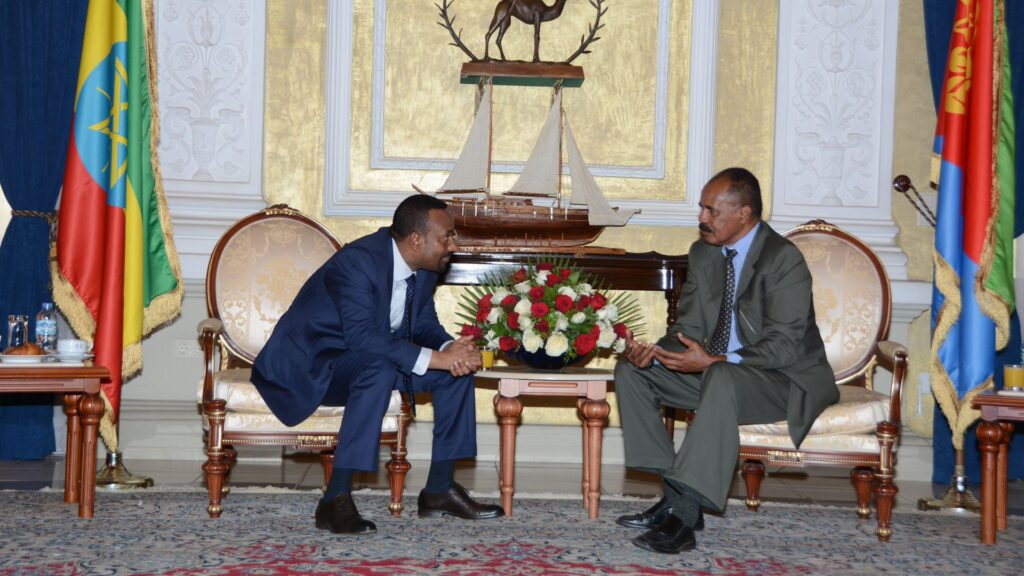
Tensions between Ethiopia and Eritrea have been ratcheting up again in recent months, sparking concerns that the Horn of Africa could see a return to conflict. The focal point is Ethiopian Prime Minister Abiy Ahmed’s fixation on regaining access to the sea for his country, which has been landlocked since Eritrea’s independence in 1993. To do so, Abiy has laid claim to the Eritrean port of Assab, located just 70 kilometers from the Ethiopian border.
Ethiopia has appealed to the international community. On Oct. 28, Abiy called for international mediation to find a “peaceful resolution” with Eritrea that would secure Ethiopia’s access to the sea. In an address to Parliament, he specifically mentioned the United States, China, Russia, and the European Union as potential mediators, though regional powers like Saudi Arabia and Turkey could also play a role. Abiy further insisted that he had “no intention of going to war with Eritrea.” “On the contrary, we are convinced that this issue can be resolved peacefully,” he added, while stressing that his country’s demand for access to the sea was “irreversible.”
Ethiopia’s pursuit of access to the sea through Eritrea has long been one of the main sources of hostility between the two countries. Though they thawed relations in 2018 and joined forces in 2020 to fight the Tigray People’s Liberation Front (TPLF) during the war in Ethiopia’s Tigray Region, tensions have returned since that fighting ended in 2020, and they have reached a new level in recent months. In a letter dated Oct. 2 addressed to UN Secretary-General Antonio Guterres, Ethiopian Foreign Minister Gedion Timothewos accused Eritrea of “actively preparing for war” against Ethiopia.
The letter denounced what it called “collusion” that had become “increasingly evident in recent months” between Eritrea and the TPLF – the two countries’ erstwhile foe in the Tigray War – allegedly aimed at “destabilizing and fragmenting Ethiopia.” According to Timothewos, both the Eritrean government and the TPLF were involved in a recent offensive by a militia from the Amhara region that sought to capture the northern city of Weldiya, sparking clashes with Ethiopian government forces.
‘Lost all trust’
How did Eritrean and Tigrayan forces go from enemies to partners so quickly? The shift is largely due to a split within the TPLF. Since April 2023, two factions within the organization have been at odds: one led by the head of the interim administration of Tigray, Getachew Reda, who is allied with Abiy and became his minister for East African affairs in April; and the other led by TPLF Chairman Debretsion Gebremichael. By late 2024, meetings had reportedly taken place in Asmara – Eritrea’s capital – between leaders of Gebremichael’s faction and representatives of the Eritrean government, with members of the TPLF’s armed wing, the Tigray Defense Forces, also present.
Since the Tigray War, Gebremichael’s faction “has lost all trust in Abiy Ahmed,” explained Yohannes Woldemariam, a professor of international relations at the University of Colorado. “Feeling sidelined, it has turned toward its Eritrean neighbor, which shares the same distrust toward Addis Ababa.”
On Oct. 8, the TPLF hit back. In its own letter to the UN, it rejected the accusations leveled against it as “completely unfounded” and denounced what it called “fabricated stories” and a “smear campaign.” The Ethiopian government’s letter “presents a dangerous inversion of reality,” the TPLF wrote, “an attempt to portray the aggressor as the victim and the victims as the aggressor.”
The following day, Eritrea in turn condemned Ethiopia’s accusations as “baseless” and a “deceitful charade.” “For the past two years,” Eritrean Information Minister Yemane Ghebremeskel said, “an intense propaganda campaign aimed at fueling irredentist ambitions has been accompanied by provocative threats.”
Even before these mutual recriminations, the two sides had been locked in a war of words. In May, during celebrations marking the 34th anniversary of Eritrea’s independence, President Isaias Afwerki delivered a blistering tirade against Ethiopia. He portrayed Abiy’s Prosperity Party as “a substitute for foreign intervention” and declared that “the once promising outlook” between the two nations had “completely faded.”
Although Ethiopia and Eritrea share a complex history marked by frequent conflict – they fought a devastating war from 1998 to 2000 that claimed as many as 100,000 lives – tensions had eased with Abiy’s rise to power in 2018 and the signing of a friendship treaty, for which he was awarded the Nobel Peace Prize. But by 2020, the un- official purpose of this reconciliation became clear: Ethiopian federal troops went to war against the TPLF with the support of the Eritrean army. The conflict was marked by credible accusations of war crimes against all sides, but Eritrean soldiers were particularly notorious, with Amnesty International reporting that they “arbitrarily executed civilians.”
Eyes on the port
According to Woldemariam, Abiy gave Eritrea “false hopes” of peace to help achieve his goals in Tigray. “Today, he is trying to rekindle Ethiopian nationalist sentiment and rally the population around the capture of Assab, which he sees as a rightful return,” he added.
Assab was under Ethiopian control until Eritrea’s independence in 1993, when it lost access to the port along with the rest of Eritrean territory. But recently, Abiy has cast doubt on the circumstances by which this happened, telling Parliament in October that “no official record or institutional decision” exists on how Ethiopia lost access to the Red Sea. “This is a desperate attempt to gain public support while the country remains completely fragmented,” Woldemariam said.
With Ethiopia already entangled in several regional conflicts, a further mobilization of the federal army in Eritrea would be “completely counterproductive” for Addis Ababa, said Zehirun Hailu, an independent analyst specializing in the Horn of Africa. “The forces are not ready for a new war, and Ethiopia is isolated in the region.”
Hailu noted that its relations with Somalia remain complicated, and Egypt is also at odds with Addis Ababa over the Grand Ethiopian Renaissance Dam, which Cairo fears will restrict its water flow from the Nile. “In this context, a new war would be disastrous.”
Despite Ethiopia’s appeals for inter- national mediation, no government has publicly responded.
Eritrea, for its part, is also seeking support. When Afwerki met with Egyptian President Abdel Fattah al-Sisi in Cairo in late October, Sisi reaffirmed his “firm commitment to supporting Eritrea’s sovereignty and territorial integrity.” That meeting and Sisi’s declaration underscored that the impact of any potential conflict between Ethiopia and Eritrea would extend far beyond their borders, with implications for all of the strategically crucial Horn of Africa region.