
Three and a half years into the Sudanese civil war, the violence persists unabated. The conflict has evolved into the world’s most severe humanitarian crisis, displacing over 14 million people. Because it is largely a proxy war, several nations are involved in supplying arms or funding to both factions. Andrew Firmin writes that it is essential to hold accountable not only the domestic leaders responsible for human rights violations but also the leaders of the foreign nations participating in the conflict by proxy.
Sudan’s civil war grinds on. It’s been three and a half years since the Sudanese Armed Forces (SAF) and the Rapid Support Forces (RSF) militia began their battle for supremacy, and the two forces and their allies continue to slaughter civilians with impunity. As a recent UN report makes clear, the killing is enabled by numerous foreign powers that continue to supply weapons, personnel, and logistical support. They have made a civil conflict their proxy war, and their self-interest is sustaining the killing.
Things are relatively quiet in the capital, Khartoum, where the curfew was recently lifted following its recapture by the SAF last year, but the RSF still controls significant areas, with fighting concentrated in the Darfur and Kordofan regions to the west and Blue Nile state in the southeast.
Both sides now extensively use drones to kill civilians. In February, a suspected RSF drone strike on an aid convoy in South Kordofan killed three humanitarian workers and wounded four more.
The RSF are also attacking El Obeid, a city of around half a million people in North Kordofan. RSF drones have hit hospitals and schools.
The war has caused the world’s largest humanitarian crisis. Over 11 million people have been forcibly displaced within Sudan or to surrounding countries, and around 20 million are experiencing acute food insecurity.
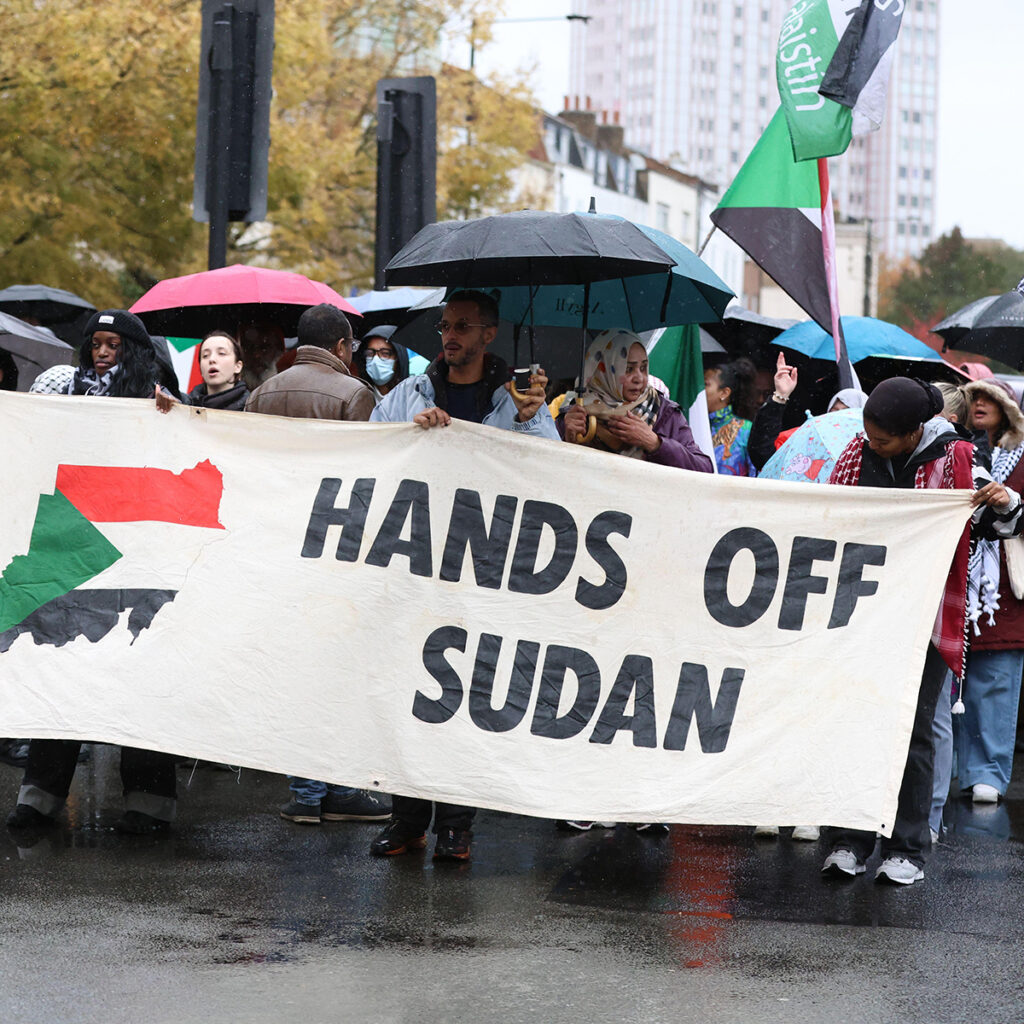
Foreign powers behind the war
Sudan’s people can expect little help from the deadlocked UN Security Council. In August, the U.S. government proposed a resolution to expand an arms embargo that currently applies to Darfur to the whole country, explicitly including drones. The Sudanese government condemned the proposal and Russia rejected it, which, given its veto power as a permanent member, means the resolution won’t advance further unless it is significantly watered down.
Russia initially sold weapons to both the RSF and SAF, but more recently has swung behind the SAF, becoming a major arms supplier in return for gold and a potential Red Sea naval base. It’s joined by several other states with a direct stake in the conflict.
Alongside Russia, the states that supply arms or other military support to the SAF, or have done so at some point since the war began, include Egypt, Eritrea, Iran, Libya, Qatar, Saudi Arabia, Somalia, Turkey, and Ukraine. Those that have backed the RSF in various ways include the Central African Republic, Chad, Ethiopia, Kenya, South Sudan, Uganda, and, most notoriously, the United Arab Emirates (UAE). Weapons originating from countries including Canada, China, Israel, and the UK have also been used. In most cases, states deny involvement.
Push for accountability
A new initiative to hold foreign figures accountable offers some hope for justice. In June, the Raoul Wallenberg Centre for Human Rights and a group of civil-society organizations made a legal submission to the International Criminal Court (ICC), asking it to investigate several foreign officials for aiding and abetting crimes against humanity, genocide, and war crimes in Sudan. The submission provided evidence of the involvement of the governments of Egypt, Iran, Turkey, and the UAE.
The ICC has an ongoing investigation into the situation in Darfur, scene of a 2003-2005 genocide. It has confirmed that human-rights crimes committed during the current war fall under its jurisdiction as part of this investigation, and in June it announced it had “concrete evidence” linking RSF leaders to atrocities in El Fasher.
It’s vital that leaders responsible for human-rights crimes face justice, and this must include the leaders of the countries waging a proxy war. If there is to be peace and justice, the impunity of the foreign powers that are sustaining the war must be challenged.