
Two months prior to the local and legislative elections in late May, the Guinean government dissolved all but the smallest opposition parties. This move represents a step towards authoritarian consolidation that, paradoxically, reveals the very insecurity the regime strives to hide. It also contradicts any optimistic interpretation of Mamadi Doumbouya’s recent attempt to gain legitimacy through his official election as president on December 28, where he reportedly received 87% of the vote. Instead of signaling a return to democratic governance, the election has led to an intensification of repression since his inauguration. Tangi Bihan reports.
On March 6, the Guinean government dissolved 40 political parties, including the most significant opposition forces in the country. The move, which came just months before legislative and municipal elections scheduled for late May, is another step along the road toward one-party rule that Guinea has taken under coup leader Mamadi Doumbouya, who won a seven-year term as president in December. It is also another step in an authoritarian consolidation that, paradoxically, betrays the very insecurity the regime works so hard to conceal.
The dissolution of the opposition parties was not entirely unexpected. Several of them had already been suspended for months on various legal grounds. What is surprising is the timing: The parties had technically been given until the end of May to come into compliance with the law, by holding party congresses or submitting financial records for the past several years. Instead, the government decided abruptly to annul them altogether.
Two parties were the core targets: the Union of Democratic Forces of Guinea (UFDG), led by Cellou Dalein Diallo, and the Rally of the Guinean People (RPG), the party of former President Alpha Condé, who was deposed in the 2021 coup led by Doumbouya. Both had already been significantly weakened, with their leaders either in exile or imprisoned and their bases of support effectively demobilized by years of government harassment. Nevertheless, they remained the only forces capable of mounting any credible challenge to Doumbouya’s hybrid military-civilian government.
Guinea’s remaining political parties are small and marginal, with neither the organizational capacity nor the credibility to mount any opposition to Doumbouya’s regime. As a result, the upcoming elections will be held without meaningful competition, with regime-aligned candidates set to win nearly every seat on offer.
This trajectory stands in direct contradiction to any optimistic reading of Doumbouya’s recent effort to achieve legitimacy through his official election as president Dec. 28, with a reported 87% of the vote. If the exercise of holding an election was supposed to mark the normalization of governance, precisely the opposite has occurred: Repression has intensified since his inauguration, not eased.
Sign of weakness?
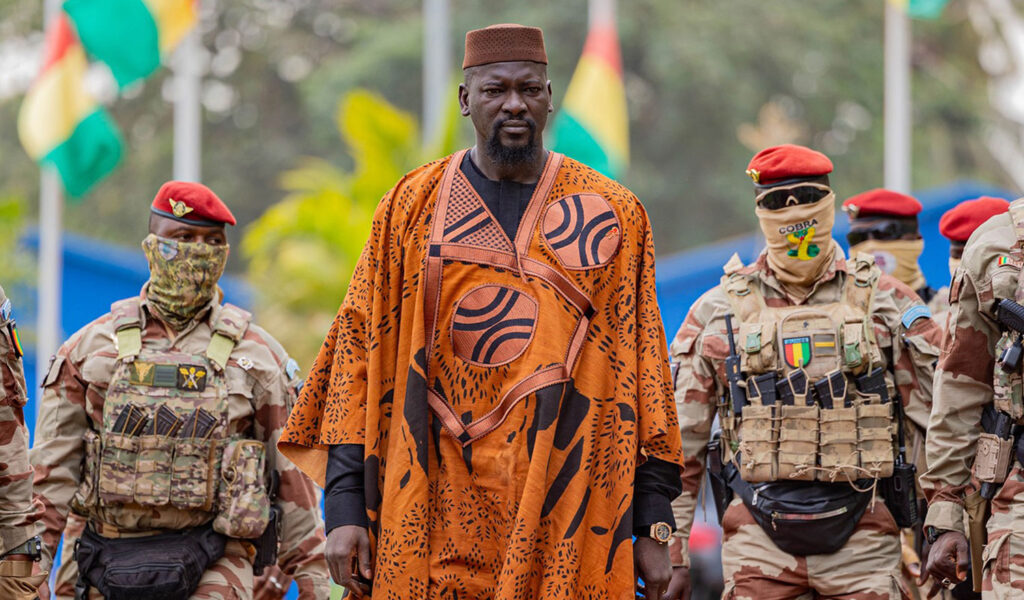
Yet the manner in which the opposition parties were dissolved – overnight and without warning – also belies the government’s narrative of a consolidation of its strength. Instead, it reveals a power that does not possess the composure it claims. That unease has been visible for months here in Conakry, Guinea’s capital. The 41-year-old Doumbouya rarely ventures outside the presidential palace and makes almost no public appearances. During the December presidential campaign, he delivered no speeches. He appeared in public only once, on the very last day of campaigning, for a brief moment in which he danced a few steps, surrounded by heavily armed members of the special forces that he once headed.
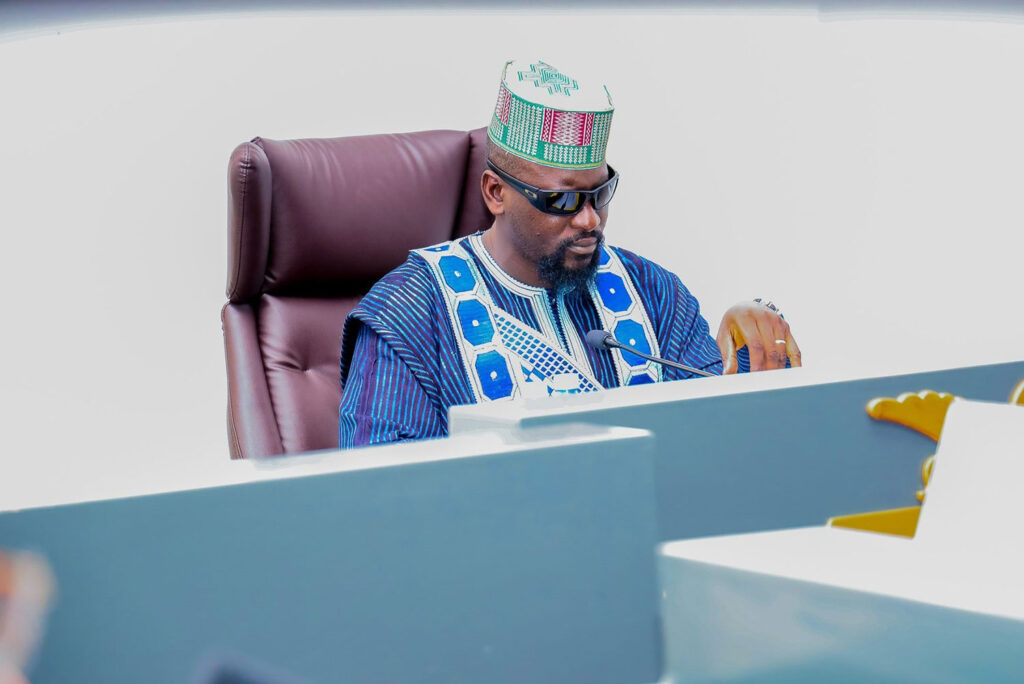
It is an open secret in Conakry that Doumbouya is not in good health, and he did not look well when he made his only campaign appearance. But it’s also possible that he did not campaign because he feared for his safety and wanted to avoid putting himself at risk.
Those concerns may not be unfounded. On the eve of the Dec. 28 vote, the army announced that it had “neutralized” members of an “armed group” with “subversive intentions” – offering no further details. According to sources who spoke on the condition of anonymity, the episode involved a disgraced officer who had retained the protection of soldiers loyal to him to prevent the army from arresting him. As is often the case with such episodes in Conakry, the full story has never emerged.
As for Doumbouya’s health concerns, the nature of his condition remains unknown. A recent episode has only fueled speculation. After attending the African Union summit in Addis Ababa on Feb. 14-15, he disappeared for three weeks. The government refused to disclose his whereabouts, though multiple sources believe he traveled to Singapore for treatment and rest. Prime Minister Amadou Oury Bah was eventually forced to acknowledge that Doumbouya was “tired” after four intense years in power and had needed “a break.”
Upon his return to Conakry, Doumbouya distributed promotions to the senior officers of his security apparatus. The gesture was widely read in the capital as a reward for the loyalists who had held the country together during his absence – an act less of authority than of gratitude.
Indeed, it may be due to the fragility of the regime that it is escalating its crackdown against the opposition. The dissolution of political parties is part of a broader and intensifying campaign against all critical voices. In July 2024, civil-society activists Oumar Sylla, also known as Foniké Menguè, and Mamadou Billo Bah were abducted by security forces. They have not been heard from since. Since then, forced disappearances have multiplied: a journalist, several associates of Condé, and multiple members of the UFDG have all been abducted by armed men, their current whereabouts unknown. The authorities continue to publicly deny any involvement in these incidents.
With many political activists, opposition figures, and critical journalists having fled into exile, the government has found a further instrument of pressure to silence them: targeting their relatives. No one has been spared – not women, not the elderly, not children. In late September, the 75-year-old father of a journalist was abducted. In November, the 14- and 16-year-old children of a musician who has been critical of the regime were abducted. In March, the mother and sister of a former minister under Alpha Condé were seized from their village – though they were released a few days later, most likely after the former minister secured the help of neighboring leaders. Doumbouya’s methods of political repression clearly draw on the model of Rwandan President Paul Kagame, whom he has invited to Conakry on multiple occasions and with whom he maintains close relations.
In Rwanda, enforced disappearance is likewise a standard instrument of political control.
The picture that emerges is one of systematic oppression directed at the regime’s opponents – a reign of terror that appears disproportionate, given that none of these individuals seem to pose any immediate threat. One possible explanation is that the authorities suspect certain dissidents of cultivating contacts within the military. But no evidence of such plotting has ever been made public.
Nevertheless, Doumbouya seems to distrust his own army. This is a paradox considering how extensively he has restructured the Guinean military since taking power, including multiple purges, new recruitment waves, and the reorganization of elite units. Influential officers have continued to die under murky circumstances – including most recently, in March, a prominent military figure who was serving a prison sentence for his role in a 2009 massacre committed under a previous junta.
International investment increases
On the international stage, by contrast, Guinea’s position is comparatively comfortable. Within West Africa, the regime has charted a distinctive course. It employs the same repressive methods as the military dictatorships of the Alliance of Sahel States (AES) – Burkina Faso, Mali, and Niger – which have also dissolved political parties and routinely resort to imprisonment and enforced disappearances. But unlike the AES members, Doumbouya has made a deliberate calculation to anchor Guinea firmly in the Western camp, judging that this is where the greatest strategic returns are to be found.
All three AES juntas broke with their neighbors in the Economic Community of West African States (ECOWAS), as well as with France, in the wake of their coups between 2020 and 2023, pivoting instead toward a privileged partnership with Russia. Guinea has made the opposite choice, deepening its military and economic cooperation with France, while actively welcoming French companies in Conakry. Military cooperation between Paris and Conakry has also intensified in recent years.
More broadly, Guinea’s strong economic performance – GDP growth is projected to reach 10% in 2026, driven by a dynamic mining sector – is drawing investors from across the world and acting as a force for stability. Partner countries and their companies all stand to profit from this dynamism, which gives them little incentive to raise concerns about the nature of the government they are dealing with. In any case, the era of applying meaningful diplomatic pressure on authoritarian governments to liberalize – to whatever extent that pressure ever genuinely existed – appears to be over.
Guinea’s government is the primary beneficiary of this comfortable situation. The exploitation of the massive Simandou iron-ore deposit – operated by Chinese companies alongside Anglo-Australian giant Rio Tinto – will generate substantial new revenues for the state, with the national budget poised for a significant expansion.
Certainly, poor economic management is evident daily. The country has been experiencing a liquidity crisis for the past year due to a crisis of confidence in the banking system. As a result, consumers and businesses can no longer make withdrawals from their bank accounts, which is a major problem in a country where most everyday transactions are conducted in cash. Despite these signs of dysfunction, substantial public revenues from the mining sector will allow the government to sustain its patronage networks, shielding it from a real economic crisis that could fuel social dis-content.
Guinea’s regime is now both more repressive and more financially secure than at any time since the 2021 coup. The dissolution of the main political parties, however, does not signal the confidence of a regime firmly in control. Rather, it reveals the anxiety of one that feels it cannot afford to lower its guard.
For those who hoped that Doumbouya’s electoral mandate in December might open the way for political normalization, the evidence instead points decisively in the opposite direction.