
February 24, 2026, marked the 60th anniversary of the military coup that ousted Ghana’s first president, Dr. Kwame Nkrumah. Declassified U.S. government documents indicate that the coup had been planned in Washington for two years prior and was supported by the U.S. Central Intelligence Agency. Baffour Ankomah revisits these facts and examines the coup’s long-term consequences, including its impact on Nkrumah’s vision for an industrialized, economically independent Ghana and pan-African unity.
In 60 years without awareness of the real facts, most Ghanaians today have accepted the revisionist history peddled by people who credit the 1966 coup that overthrew the country’s first president, Dr. Kwame Nkrumah, solely to the local actors who were used by the U.S. Central Intelligence Agency (CIA) as its public face.
Feb. 24 marked the coup’s 60th anniversary, and it is time for the true facts to be restated. Simply put: Nkrumah’s overthrow was the work of the U.S. government, supported by Great Britain and a few allies. President Lyndon B. Johnson and top U.S. officials had decided to get rid of Nkrumah two years before, and they farmed out the execution of the plan to the CIA.
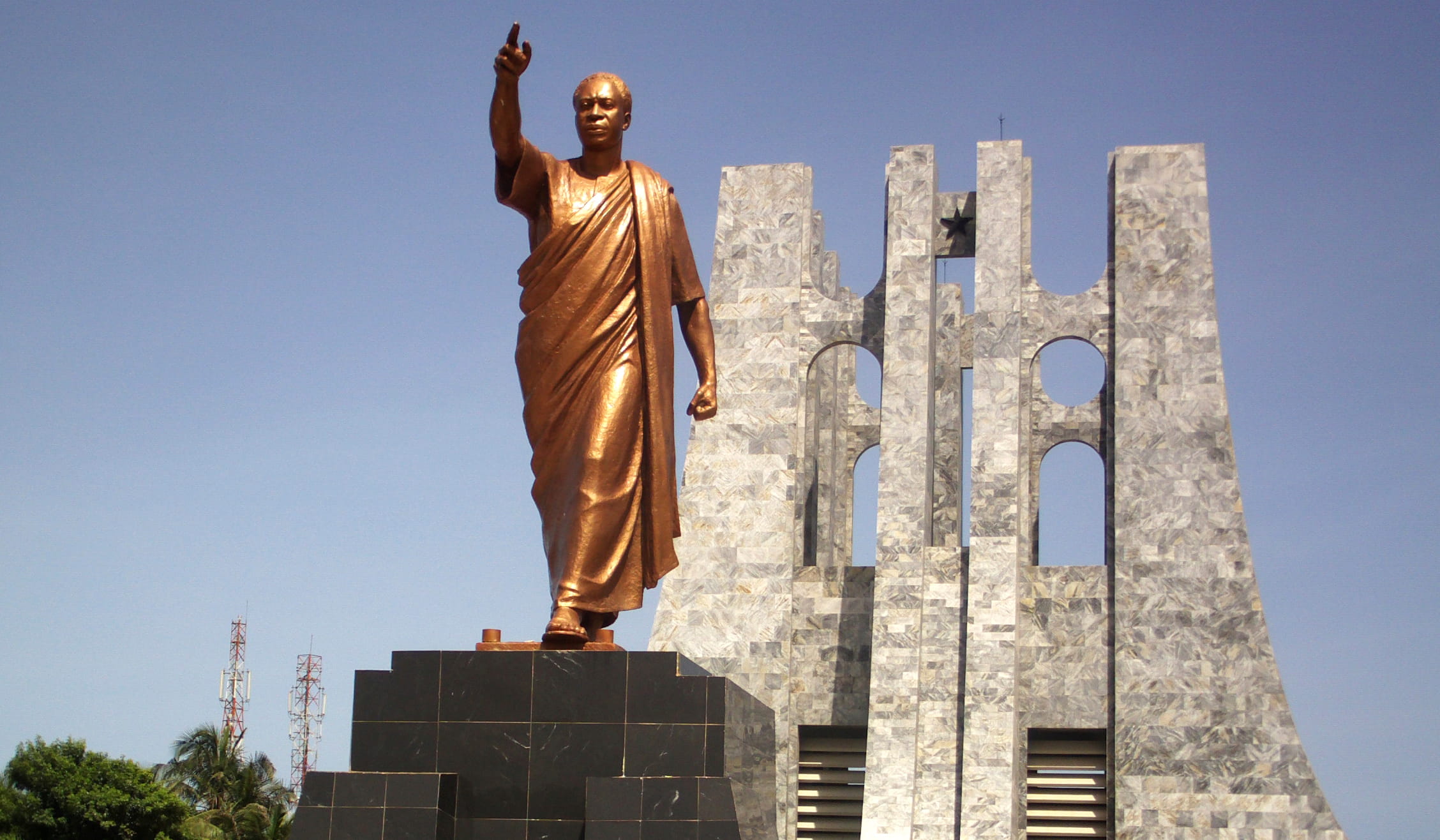
The CIA then recruited local Ghanaian lackeys and traitors as the public face of the project, because the Americans could not come through the front door and do the job themselves with an open military invasion. All this is detailed in U.S. government documents declassified in 1999.
One of the documents shows that on February 6, 1964, two years before the coup, the then U.S. Secretary of State Dean Rusk and CIA Director John McCone met to pick Ghanaian General Joseph Arthur Ankrah (popularly known as J.A. Ankrah) as the man to replace Nkrumah.
On that same day, William C. Trimble, director of the State Department’s West Africa desk, wrote a memo entitled “Proposed Action Program for Ghana” to G. Mennen Williams, assistant secretary of state for African affairs and the former governor of the state of Michigan.
“Although Nkrumah’s leftward progress cannot be checked or reversed, it could be slowed down by a well-conceived and executed action program,” Trimble wrote. “Measures which we might take against Nkrumah would have to be carefully selected in order not to weaken pro- Western elements in Ghana or adversely affect our prestige and influence elsewhere on the continent.”
Trimble argued that “U.S. pressure, if appropriately applied, could induce a chain reaction, eventually leading to Nkrumah’s downfall. Chances of success would be greatly enhanced if the British could be induced to act in concert with us.”
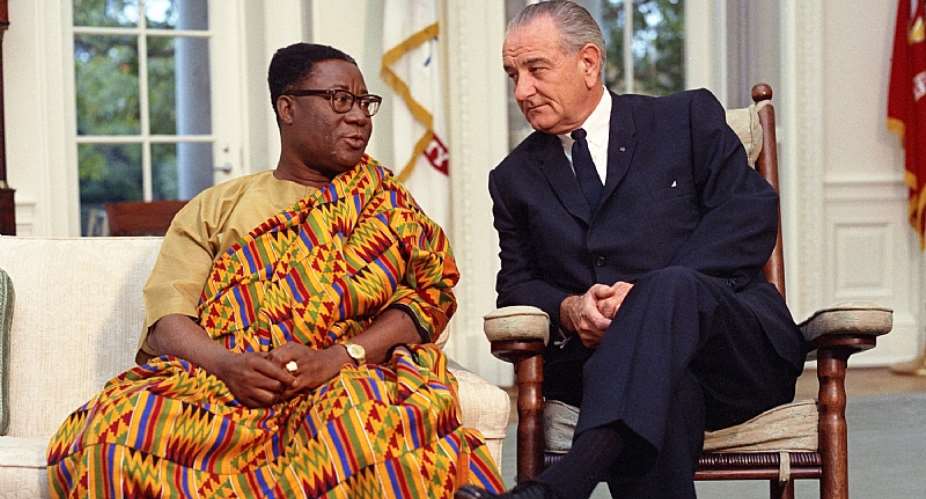
It worked. On March 12, 1966, three weeks after the coup, Robert W. Komer, Johnson’s special assistant on national security, wrote in an assessment for the President: “The coup in Ghana is another example of a fortuitous windfall. Nkrumah was doing more to undermine our interests than any other black African. In reaction to his strongly pro-communist leanings, the new military regime is almost pathetically pro-Western.”
Kwame Nkrumah’s premiership and presidency overlapped with the terms of three American presidents – Dwight D. Eisenhower, John F. Kennedy, and Johnson. While Eisenhower and Kennedy were more understanding and accommodating of Nkrumah, Johnson was not. It was his government that decided to get rid of the Ghanaian president.
Why Nkrumah was overthrown
To understand what really happened, it is critical to get the proper context of the coup and the real measure of Nkrumah as a staunch pan-Africanist leader.
His rise as the foremost champion of Ghanaian and African causes unfortunately coincided with the Cold War that arose after World War II, the more than 40 years of global confrontations between the U.S. and its Western allies on one side, and the Soviet Union and its allies on the other.
This duo-polar world made no allowance for independent thinking and action. You were either with the Americans or with the Soviets. Anybody who tried to stand in the middle, among the “Third World” nations of Africa, Asia, and Latin America not allied with either side, became fair game.
Nkrumah defined his political program as “African socialism.” Although it was very far from Soviet-style communism, he was condemned as a “communist” by the U.S. and its Western allies.
This was the toxic environment in which Nkrumah rose and governed. And his rhetoric and actions did not help.
Declaring Ghana’s independence on March 6, 1957, Nkrumah told the world: “Today there is a new African in the world, and that new African is ready to fight his own battles and show that after all the black man is capable of managing his own affairs. We are going to demonstrate to the world, to the other nations, that young as we are, we are prepared to lay our own foundations.”
And he was not finished. “The independence of Ghana is meaningless unless it is linked up with the total liberation of Africa,” he thundered.
By the end of 1960, 18 African countries had gained their independence from colonial powers. Another 15 followed over the next eight years.
“The fortunes of Ghana – the first Tropical African country to gain independence – will have a huge impact on the evolution of Africa and Western interests there,” the CIA presciently predicted in a December 1957 report.
This sent alarm bells ringing in Western capitals. At the time, the West was very dependent on Africa’s natural resources, and there was the fear that a confident and independent Africa would use those resources to build its own prosperity, at the expense of U.S. and European companies that had profited from those resources. That would also give Africa a measure of freedom from Western power and influence, especially in the context of the Cold War. So Nkrumah had to be stopped before he affected the whole of Africa.
Unfortunately, Nkrumah’s grand vision for Ghana had an Achilles’ heel. He proposed turning the country into an industrialized nation in just one generation, much as Singapore, for example, would do in the 25 years after it became independent in 1965. A nation that would manufacture all its needs and export the surplus. A nation that would catch up with the industrialized nations of the West and compete with them on an even field. A model that Nkrumah wanted the African countries that would gain independence after Ghana to follow.
Economic independence
Nkrumah believed that model would bring a bright future for Ghana and Africa. But it demanded huge amounts of electricity to succeed. So he threw himself into getting the Volta River Project established. He intended that the project, centered around the construction of the Akosombo Dam, would provide enough power for Ghana to refine its bauxite ore into aluminum, freeing it from the economic trap of exporting only raw commodities.
In his book, Africa Must Unite, published in 1963, Nkrumah explained the rationale behind the Volta River Project, and why he wanted it so badly:
“Foremost of all would be economic independence, without which our political independence would be valueless,” Nkrumah explained. “Under colonial rule, a country has very restricted economic links with other countries. Its natural resources are developed only insofar as they serve the interests of the colonial power…. In planning national development, the constant fundamental guide is the need for economic independence.”
The goal in the industrial sphere, he went on, was “to encourage the establishment of plants where we have a natural advantage in local resources and labor, or where we can produce essential commodities required for development or for domestic consumption.”
In 1961, he noted, over 60 new factories were opened in Ghana, including a distil-lery, a coconut-oil factory, a brewery, a milk-processing plant, and a truck and bicycle plant. In addition, agreements were signed to construct “a large, modern oil refinery, an iron and steel works, a flour mill, and sugar, textile, and cement factories.”
“Unless we attain economic freedom, our struggle for independence will have been in vain, and our plans for social and cultural advancement frustrated,” Nkrumah wrote. “All industries of any major economic significance require, as a basic facility, a large and reliable source of power. In fact, the industrialization of Britain, America, Canada, Russia, and other countries too, emerged as a result of the discovery of new sources of energy. Newer nations, like our own, which are determined to catch up, must have a plentiful supply of electricity if they are to achieve any large-scale industrial advance.”
That was the justification of the Volta River Project. Combined with the expansion of the port and harbor at Tema, he said, it would “have a massive effect on our national economy and enlarge its development.”
Nkrumah, therefore, expended a lot of energy on the Volta project. He planned it as the core of an integrated industrial program, centered on a smelter to process Ghanaian bauxite into aluminum, and including irrigation for nearby farmland. But the project was unfortunately hijacked by outside forces beyond his control.
In the end, Nkrumah got a watered-down version of the project. The World Bank loaned it $47 million and the U.S. government $30 million, more than half the $150 million cost of the dam. The American aluminum refiners Kaiser and Reynolds put up the $32 million in initial costs for the smelter, but demanded that they be able to use imported alumina instead of Ghanaian bauxite. They also got electricity from the dam at a price less than half what any other refinery in the world was paying for power.
The project was commissioned on January 26, 1966, less than a month before Nkrumah was overthrown. Still, before the coup, he had managed to build 68 huge factories, and they served as sources of employment for Ghanaians for many years afterwards. No Ghanaian leader since then has equaled that feat.
A 1971 CIA report that was declassified in 2010 assessed the Volta River Project as a “limited success.” But the Ghanaian government, it estimated, was losing $2 million a year by selling the smelter electricity at such low rates.
“Near-term prospects for an alumina plant to process local bauxite appear dim,” it concluded.
Nkrumah of Africa
Nkrumah did not only build Ghana. He took his pledge of March 1957 – “The independence of Ghana is meaningless unless it is linked up with the total liberation of Africa” – very seriously, and helped other African countries then under colonial rule to push the colonialists out.
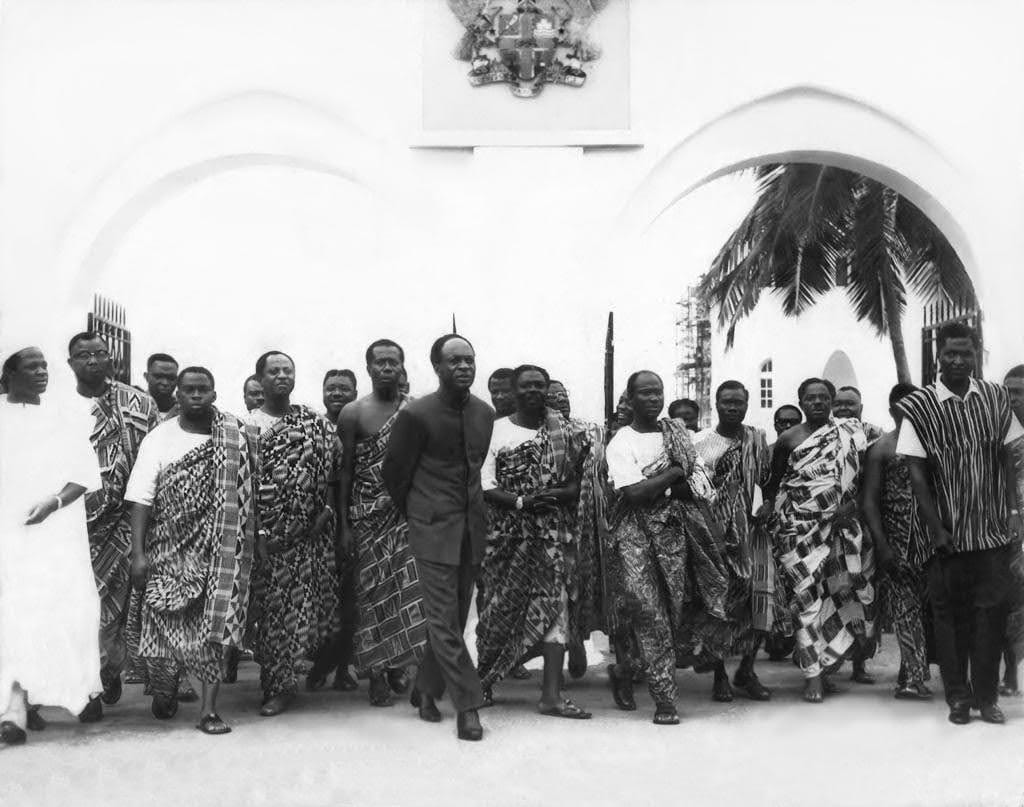
He helped the cause of African independence with funds, military materiel, and moral support. He set up bases in Ghana to train guerrilla freedom fighters, and organized conferences in Accra to sharpen the mental faculties of colonized Africa, bringing other leaders up to speed politically and diplomatically.
Politically, Nkrumah wanted a united Africa, with a continentally federated government like that of the United States of America.
In his famous speech at the founding of the Organization of African Unity in May 1963 in Addis Ababa, Ethiopia, Nkrumah pushed for a “continent-wide plan for a unified or common economic and industrial program for Africa.” He envisioned that it would include a common market for Africa; an African monetary zone with a common currency; an African central bank; a continental communication system; a common foreign policy, diplomacy, and system of defense; and a common African citizenship.
Nkrumah was light-years ahead of his compatriots who did not see what he was seeing, and thus frustrated his efforts. Some of them, like Presidents Julius Nyerere of Tanzania and Abubakar Tafawa Balewa of Nigeria, were used by Britain and America to checkmate Nkrumah’s African-unity project.
In March 1997, at Ghana’s 40th independence celebrations, President Nyerere went to Accra and confessed to the nation that “Nkrumah was right, we were wrong.” But it was too late. By then Nkrumah had been lying in his grave for 25 years, having died in exile in Bucharest, Romania, on April 27, 1972.
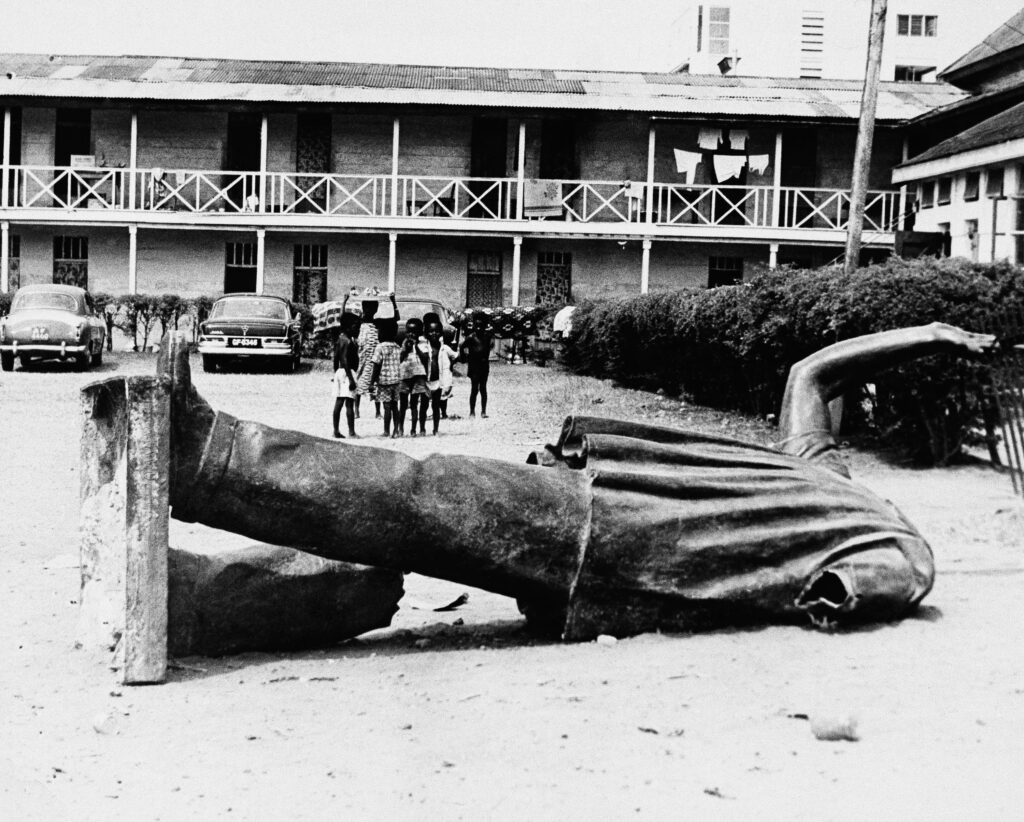
What Nyerere and the others had fought against was the obvious fact that a united Africa was bad news for the West which was then depending on Africa’s natural resources for much of what it needed to survive and continue as the dominant global economic power (as it still is). So anybody, like Nkrumah, who was pushing for a united Africa was thus an enemy who had to be eliminated from power.
‘Brought low by the cocoa price’
“Intensive efforts should be made through psychological warfare and other means to diminish support for Nkrumah within Ghana and nurture the conviction among the Ghanaian people that their country’s welfare and independence necessitate his removal,” William C. Trimble, the director of the U.S. State Department’s West Africa desk, wrote in a memo to G. Mennen Williams, assistant secretary of state for African affairs, on Feb. 6, 1964.
At the time, cocoa was Ghana’s major export earner. In 1955, cocoa exports made up 68% of Ghana’s total trade abroad. In 1971, it provided 95% of the country’s income from agricultural exports.
Unfortunately for Nkrumah, Ghana did not control the international cocoa price. It was set by Western markets.
In the mid-1950s, demand for cocoa outstripped supply, and the price rose to a record high. In 1954, it averaged £374 per metric ton (then US$1,047) in Britain, and in New York, wholesale prices went as high as 68.9 cents a pound.
Prices fluctuated widely over the next decade. In 1964, the year Nkrumah launched his seven-year development plan, cocoa imports cost £192 a ton, according to British parliamentary records. But in 1965, after a world-record bumper crop the year before, prices plummeted to historic lows. The price per ton fell to £89 ($249), and in the New York market, a nadir of 12.2 cents per pound that July.
That deprived Ghana and Nkrumah of the funds needed to embark on a speedy industrialization program. As Ghana’s economy suffered, disaffection grew tall at home against Nkrumah.
At one point, the former Bank of Ghana governor J.H. Frimpong-Ansah said in a BBC documentary in the 1990s, Nkrumah was told that Ghana was so bankrupt that it had only £1 million in its reserves in the Ghana Bank in London. Nkrumah, according to Frimpong-Ansah, turned around and asked if the bank manager in London had not forgotten some zeros behind the one million.
“No, Mr. President, the manager has not forgotten any zeros. That is all we have,” Frimpong-Ansah said Nkrumah was told. The President of Ghana left the room, and was heard crying in the next room.
In 1999, when the papers of Britain’s World War II hero Field Marshall Bernard Montgomery were declassified, the documents on Africa showed, in the words of The Times of London, that “Nkrumah was brought low by the cocoa price.”
“The dramatic decline in prices in the early 1960s severely damaged Ghana’s economy, leading to debt, inflation, and shortages of imported goods,” The Times wrote in a fairly lengthy article. And the collapse of the Ghanaian economy, it added, was a primary factor in Nkrumah’s overthrow.
While the troubles on the economic front intensified under Nkrumah, the Americans and their Western allies increased their support for the Ghanaian opposition, giving them funds and anti-democratic strategies (some very violent, including assassination attempts on Nkrumah), aimed at making the country ungovernable.
Seeing his vision of a prosperous Ghana being sabotaged, Nkrumah adopted an anti-democratic response to counter the opposition’s unpatriotic acts. He converted the country to a one-party state and introduced detention without trial, and jailed many of his political opponents, even some of his former ministers.
This played into the hands of his detractors, who saw his response as “despotism.”
All this abetted the psychological warfare that the Americans had unleashed against Nkrumah as part of their plan to weaken him internally and bring his government down.
The U.S. and its Western allies employed similar tactics throughout the Cold War against leaders such as Chile’s socialist President Salvador Allende, to undermine his government before the 1973 coup that replaced him with a brutal military government. They unleashed them again against President Robert Mugabe of Zimbabwe from 2000 onwards, when Mugabe’s government embarked on a fast-track land reform program to redistribute land from white farmers to black farmers. They pushed for regime change in Zimbabwe, sponsoring the opposition with funds and undemocratic tactics in a bid to defeat Mugabe.
When Mugabe responded in kind, he became a “dictator,” “despot,” and even a “Hitler.” But Mugabe survived, even though the Zimbabwean economy collapsed so catastrophically that it recorded one of the highest inflation rates the world has ever seen.
The upside of all this is that black Zimbabweans got their stolen ancestral land back, and today hundreds of thousands of them have become prosperous farming the land. Ghanaians, in contrast, lost out, because Nkrumah was defeated, and so his dream of turning Ghana into an industrialized, economically independent nation was frustrated.
How the coup proceeded
According to the CIA documents declassified in 1999, and former CIA officers who have written books about it, Nkrumah’s overthrow was masterminded by Lyndon Johnson’s government in collaboration with Britain and France.
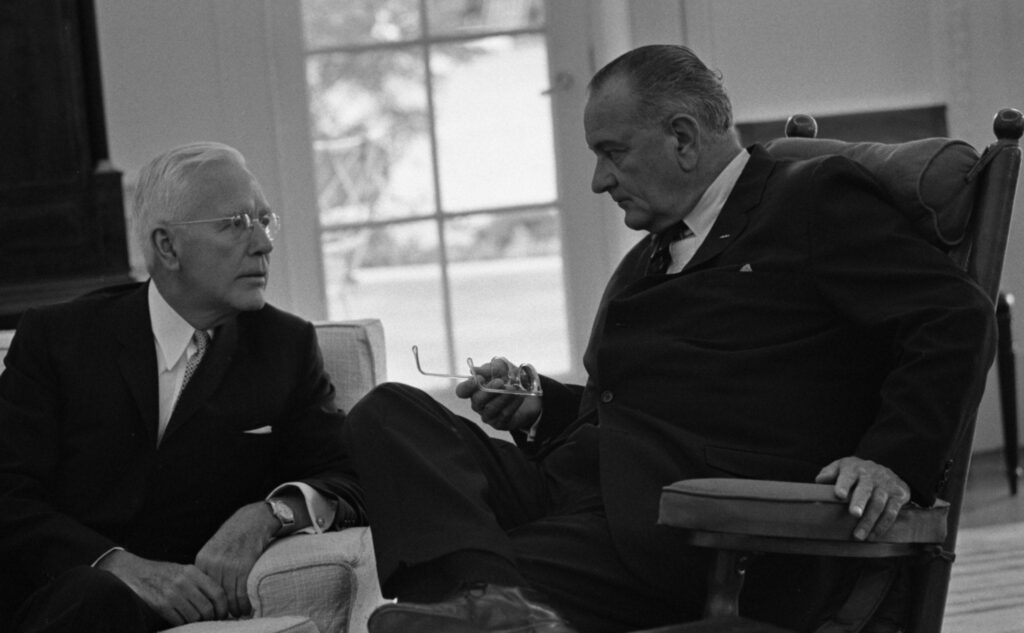
As earlier mentioned, the 1999 declassified documents show that the American government officials started talking about Nkrumah’s overthrow as far back as February 1964, when Secretary of State Dean Rusk and CIA Director John McCone met and picked General J.A. Ankrah as Nkrumah’s replacement.
Ankrah and other Ghanaian military officers, such as Major General Stephen Otu, the chief of the defense staff, had been recruited by the CIA in what is now the Democratic Republic of the Congo, when the Ghanaians were part of the United Nations peacekeeping force there during the crisis of the early 1960s. They came back home to await instructions – and all this unbeknown to Nkrumah.
According to the declassified documents, the action quickly snowballed into America recruiting Britain and France.
On Feb. 12, 1964, President Johnson met with UK Prime Minister Alec Douglas-Home at the White House to discuss Nkrumah. They were joined by UK Foreign Secretary Richard Butler, Secretary of State Rusk, veteran U.S. diplomat W. Averell Harriman, and McGeorge Bundy, special assistant to the president on national security affairs.
“One could not be sure how long Nkrumah would last,” Butler said at the meeting, according to the minutes released with the declassified documents.
Another meeting on Nkrumah was held at the White House on February 26, 1964. Present this time were McCone, aluminum magnate Edgar Kaiser (who was then working with Nkrumah on the Volta River Project), and William P. Mahoney, the U.S. ambassador to Ghana.
The declassified documents record McCone as saying at the meeting: “I asked Ambassador Mahoney if he felt that the CIA was operating independently of his office [in Accra]… Mahoney answered absolutely and positively no.”
Mahoney then returned to Accra and went to see Nkrumah on March 2, 1964. According to the declassified documents, he reported back to Washington, thus:
“I said [to Nkrumah] that I am in full control of all U.S. government activities in Ghana. I could assure him without hesitation that during my incumbency absolutely nothing has been done by any U.S. agency which could be construed in any way as being directed against him or his government. Nkrumah replied with words to the effect: ‘I will take your word for it.’”
Mahoney continued that he had “repeated that there had been no conceivable activity on our part to subvert or overthrow him,” and that the “wild accusations” in the Ghanaian press that the U.S. was acting against Nkrumah were inconsistent with “our entire aid effort, aimed at assisting and strengthening his government.”
He added that, “speaking frankly, our main intelligence effort is to keep an eye on his Soviet and Chinese friends, whose activities are really large-scale.” He said they had begun an effort “to dispel some of Nkrumah’s misconstructions on [the] role of the CIA,” but “pressure should be kept up.”
On March 23, 1964, Mahoney again sent a telegram to Washington, saying: “I believe someone has to keep hammering him.
On April 9, 1964, acting on Mahoney’s advice, G. Mennen Williams wrote an action memo to Averell Harriman, saying America should “keep continuing pressure on [Nkrumah] to maintain his relations with the U.S. on a tolerable basis … We shall consult with the British in the next few days to discuss what contribution they may be able to make in this area.”
Almost a year later, on March 11, 1965, McCone, Mahoney, and others met in McCone’s office to take the “Nkrumah project” a step further. According to the 1999 declassified documents, the topic was “Coup d’état plot, Ghana.”
The minutes of that meeting show Mahoney telling McCone that Western pressure was working against Nkrumah. “Popular opinion is running strongly against Nkrumah,” he said, “and the economy of the country is in a precarious state.”
However, Mahoney was “not convinced that the coup now being planned by Acting Police Commissioner J.W.K. Harlley and Generals Stephen Otu and Joseph Ankrah would necessarily take place.” Yet, he was sure that “one way or another, Nkrumah would be out within a year.”
According to the minutes, McCone asked Mahoney: “Who would most likely succeed Nkrumah in the event of a coup?”
The answer: “Ambassador Mahoney stated that initially, at least, a military junta would take over.”
Mahoney was supported by Robert W. Komer, an old CIA hand who had replaced McGeorge Bundy as President Johnson’s assistant for national security affairs.
“We may have a pro-Western coup in Ghana soon. Certain key military and police figures have been planning one for some time, and Ghana’s deteriorating economic condition may provide the spark,” Komer, according to the declassified documents, advised his bosses. “The plotters are keeping us briefed, and State [Department] thinks we’re more on the inside than the British. While we’re not directly involved, I’m told, we and other Western countries (including France) have been helping to set up the situation by ignoring Nkrumah’s pleas for economic aid … All in all, looks good.”
Black man to do the dirty work
In January 1966, having finished his job of softening the ground for a coup, Ambassador Mahoney was recalled home. In his place, Washington sent an African-American to Accra: Ambassador Franklin H. Williams, who had been Nkrumah’s classmate at Lincoln University, the Black college in the state of Pennsylvania where Nkrumah earned degrees in economics, sociology, and theology.
Williams had been in Accra for barely a month when the coup happened. Nkrumah was in Beijing, the Chinese capital, en route to Hanoi, the Vietnamese capital, with a peace proposal to end the American war in Vietnam.
Four African leaders sent Nkrumah immediate messages of support and invitations to stay. They were President Gamal Abdel Nasser of Egypt, President Modibo Keita of Mali, President Sekou Toure of Guinea, and President Julius Nyerere of Tanzania.
In the event, Nkrumah decided to accept Sekou Toure’s invitation, because the Guinean leader shared Nkrumah’s pan-African objectives, encompassing the liberation of the African people from all forms of social injustice and economic exploitation.
He also had a strong brotherly bond with Toure, and Guinea was close to Ghana, where Nkrumah was determined to return to carry on his work.
Nkrumah arrived in Guinea on March 2, 1966. The next day, Toure held a mass rally at the Conakry stadium and announced that he was stepping down and making Nkrumah president. Nkrumah refused the offer, agreeing only to become a co- president.
Nkrumah never forgave Franklin H. Williams. In his 1968 book Dark Days in Ghana, he said Ambassador Williams’ “treachery provides a sharp reminder of the insidious ways in which the enemies of Africa can operate. In the U.S., the ‘Uncle Tom’ figure is well known. We have mercifully seen less of him in Africa.”
On July 21, 1969, Dr. Marvin Wachmann, the outgoing president of Lincoln University, wrote to Nkrumah, then in exile in Conakry, saying he “would like to write a word on behalf of Franklin H. Williams of the Class of 1941.” Williams, Wachmann wrote, “is a very bouncy and vigorous individual, and I have never seen him so crushed as he has been, concerning your feelings that he was involved in some way in the episodes in Ghana. He has assured me, personally, that he had no knowledge of the coup.”
Nkrumah was not amused. “It is extremely unlikely that Williams did not know what was going on in the embassy with CIA officers operating from there,” he told June Milne, who was his research and editorial assistant for 15 years, and later his publisher and literary executrix.
Years later, in her 1990 book, Nkrumah, the Conakry Years, Milne wrote that she had been rereading some of the notebooks she’d written while she was his assistant, between Ghana’s independence in 1957 and Nkrumah’s death in 1972.
“I wrote daily accounts of our many meetings both before 1966, the year of the coup, and afterwards. The value I attach to the notebooks is because they were written at the time. Not from memory or hindsight,” she said. “A notebook entry made during the first week in February 1966 is significant because it was only three weeks before the coup. It was at a time when Nkrumah was preparing to travel on the peace mission to Hanoi.”
Milne was with him in his office in the Osu Castle in Accra while he was checking the page proofs of his book, Challenge of the Congo. Occasionally, she recalled, “he asked if I thought he had used the most appropriate word in a particular context. ‘It is your language, not mine,’ he said.”
“We were suddenly interrupted by the appearance of Foreign Minister Alex Quaison-Sackey, to report that he had just received an urgent message from the Ghanaian ambassador in Washington,” Milne wrote. “President Lyndon Johnson wished to assure Nkrumah that America would stop the bombing of Hanoi to allow his aircraft to land safely. He could, therefore, travel to Vietnam with his peace proposals ‘in perfect safety.’
“Why were the Americans anxious for Nkrumah to leave Ghana – especially when he had suggested peace talks could be held in Accra? For some months, Nkrumah had been working on a peace plan. But a coup to remove him from power was in the final stages of planning. For it to succeed, it was imperative that he was out of the country, and as far away as possible to ensure he would be unable to make a quick return.”
After the coup, she continued, “rampaging soldiers senselessly burned the entire contents of Nkrumah’s office in Flagstaff House in Accra. While Nkrumah had time to write in Guinea, it has to be remembered that before the coup, he had been assembling material for a book on Rhodesia and the settler problem in Africa, which was published posthumously as Rhodesian File.”
America’s coup, not Kotoka’s
June Milne’s suspicions had been confirmed 12 years earlier by former CIA officer John Stockwell.
“Howard Bane, who was the CIA station chief in Accra engineered the overthrow of Kwame Nkrumah,” Stockwell wrote in his 1978 book, In Search of Enemies, A CIA Story. “Now, obviously, you can look at it in different ways. A Ghanaian might say ‘I thought we did it.’ Inside the CIA, though, it was quite clear. Howard Bane had a double promotion and an Intelligence Star for having overthrown Kwame Nkrumah in Ghana.
“The magic of it, what made it so exciting for the CIA, was that Howard Bane had had enough imagination and drive to run the operation without ever documenting what he was doing, and to sweep along his bosses in such a way, they knew what he was doing, tacitly they approved, but there wasn’t one shred of paper that he generated that would nail the CIA hierarchy as being responsible.”
This should tell the revisionist historians in Ghana today how wrong they are in crediting the coup to Lieutenant General Emmanuel Kwasi Kotoka, one of the its leaders, who was killed in a coup attempt by junior armed forces officers on April 17, 1967.
From the above, it is clear that Kotoka and the others did not originate Nkrumah’s ouster.
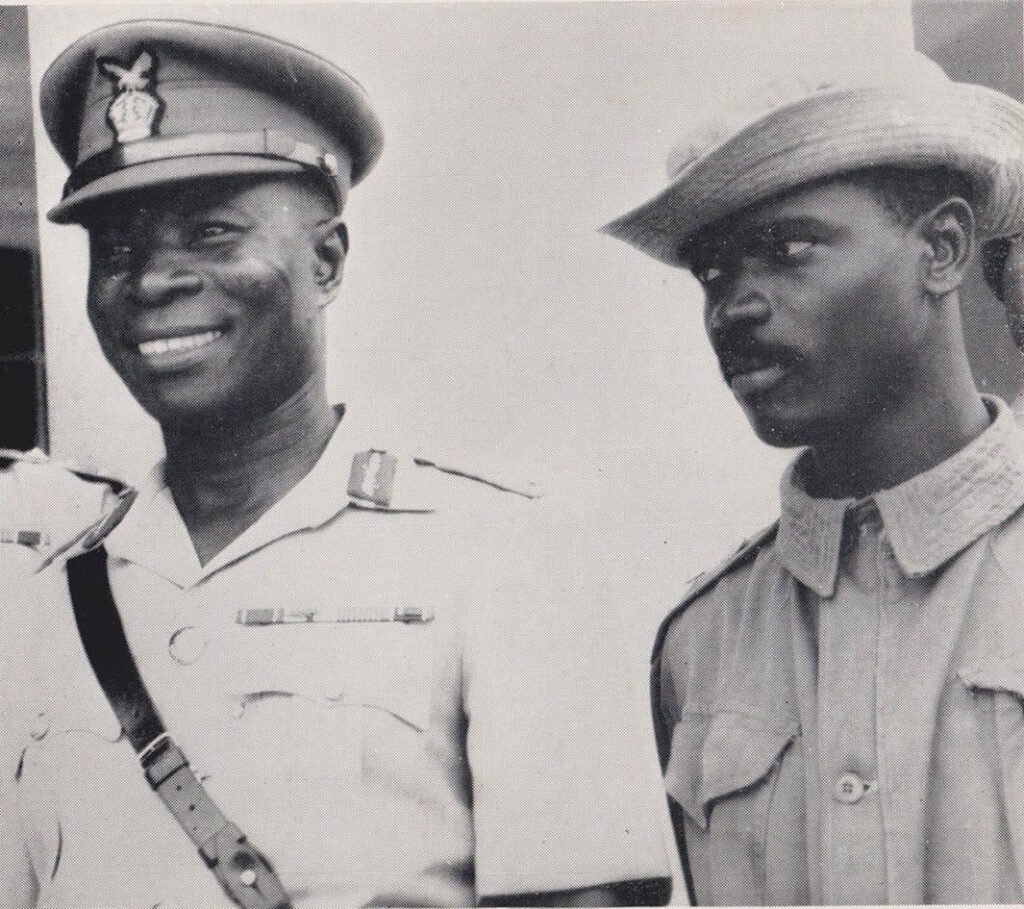
The coup against Nkrumah was not unique. During the Cold War, the CIA orchestrated or abetted the overthrow of left-leaning leaders such as Mohammed Mossadegh in Iran, Jacobo Arbenz in Guatemala, Patrice Lumumba in the Congo, and Salvador Allende in Chile.
“Destabilization is not a new thing,” former Cote d’Ivoire President Felix Houphouet-Boigny told the Paris-based magazine Jeune Afrique in an interview published in February 1981. “Did you know why Idi Amin made his coup in 1972? It was not him who did it, but the British. He did not even know what he wanted himself.
“It was the same in Ghana when the military overthrew Nkrumah,” Houphouet-Boigny continued. They [the Ghanaian coupists] came to see me. I asked them why. They replied: ‘All is not well anymore.’ Is that all, [I asked them]. I also asked them what they were going to do; they did not know. People outside knew it for them.”
After the coup, Kotoka and the other coup leaders formed the National Liberation Council, which ruled the country until October 1, 1969, when they handed over power to Dr. Kofi Abrefa Busia, who had been elected prime minister that August. Nkrumah’s Convention People’s Party was banned from participating in that election.
The NLC’s eight members, in addition to Kotoka, were: Lt-Gen J. A. Ankrah, Lt-Gen Akwasi Amankwaa Afrifa, Deputy Commissioner of Police B.A. Yakubu, Major-Gen Albert K. Ocran, Inspector General of Police J.W. Harlley, Commissioner of Police CID A.K. Deku, and Commissioner of Police Administration J.E.O. Nunoo.
Ankrah, chosen by the Americans in 1964 to replace Nkrumah, became Ghana’s head of state immediately after the coup. He continued in that position as NLC chairman until April 2, 1969, when he was forced to resign following a bribery scandal.
Kotoka, a colonel at the time of the coup, was promoted to major general soon afterwards, and to lieutenant general in February 1967. Afrifa, a major, was moved up the ladder to lieutenant general within three years. He became head of state when Ankrah resigned.
One Ghanaian historian has been saying in recent years that Kotoka was killed because his NLC colleagues objected to his call to bring Nkrumah back a year after the coup. Kotoka, in this version, wanted Nkrumah back because the NLC had not achieved much, and the Americans had failed to live up to their promises.
Kotoka was the sole person killed in the April 1967 coup attempt, led by Lieutenant Moses Yeboah. He was shot dead near the Accra International Airport, which was later renamed after him. The historian says his NLC colleagues renamed it to “cover their tracks.” This take is difficult to believe, but time will tell if any truth can be attached to it.
But all said and done, 60 years after his overthrow, and 54 years after his death, Nkrumah surely must be turning in his grave. His vision of an industrialized Ghana prosperous in all its ramifications, let alone that of a united Africa, has truly gone with the wind.