
In a bid to compete with his mentor-turned-rival, ousted prime minister Ousmane Sonko, Senegal’s President Bassirou Diomaye Faye launched his own Kiiraay political party in late July. The move is a clear attempt to rebuild his domestic power and regional standing. Faye has made overtures to the country’s old-guard establishment. Notably, he endorsed Macky Sall – the former president who jailed him during a crackdown on political opponents – for UN secretary-general. He has also reconnected with leaders of the Alliance of Sahel States, a bloc whose sovereignty-centered critique of Western and French influence strongly appeals to Senegalese youth. The first real electoral test for the Kiiraay party will arrive during the January 2027 local elections. This vote will serve as a direct referendum on whether Faye or Sonko commands Senegal’s grassroots political networks, setting the stage for a presumed face-off in the 2029 presidential race. Lesley Anne Warner reports.
Senegalese President Bassirou Diomaye Faye had what could be conservatively characterized as a busy end of July. On the 20th, he directed his Foreign Ministry to endorse his predecessor, Macky Sall, who is running to succeed António Guterres as secretary- general of the United Nations. Five days later, he launched his own political party after his split earlier this year from his erstwhile ally, former Prime Minister Ousmane Sonko of the African Patriots of Senegal for Work, Ethics, and Fraternity party (PASTEF).
Finally, on the 28th, in his first trip abroad as chairman of the Economic Community of West African States (ECOWAS), he traveled to Bamako to meet Mali’s military-backed president, Assimi Goïta. This flurry of activity, coming just over two months after his falling out with Sonko, illustrates Faye’s efforts to rebuild his domestic power and regional standing – and in doing so, reclaim some of the power he lost when their partnership collapsed in May.
Faye and Sonko came to power together in 2024. Both men had been jailed under the Sall administration, and Sonko had been barred from running for president following a conviction widely seen by his supporters as politically motivated. Sonko then backed Faye, his longtime ally, to stand in for him on the ballot, as the party promoted the slogan “Sonko is Diomaye” to legitimize the switch. After a general amnesty secured their release days before the election, Faye won in the first round on their shared platform of economic sovereignty, and appointed Sonko as prime minister.
However, governing soon brought them face-to-face with a major scandal over billions of dollars in hidden debt that had accumulated under the Sall administration and was only discovered in September 2024.
From then, it was only a matter of time before their paths diverged. Faye moved to start negotiations with the International Monetary Fund over a bailout, accepting the politically painful austerity measures that would accompany it. Sonko, however, denounced debt restructuring, fuel-price increases and other IMF-backed measures as compromises of Senegalese sovereignty. In May, Faye dismissed Sonko as prime minister. Sonko then engineered his own election as speaker of the National Assembly, placing PASTEF’s parliamentary majority in his hands.
Overtures to the old guard
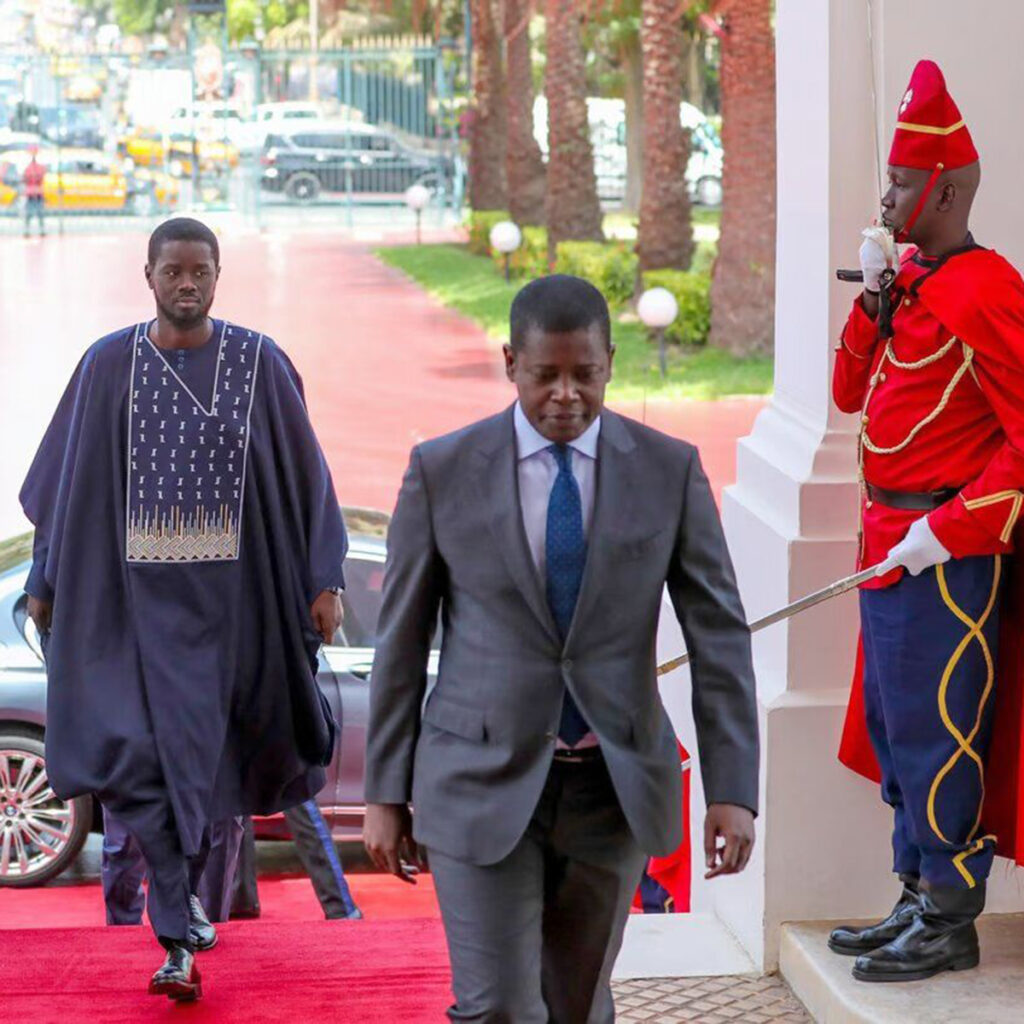
The rupture with Sonko, and by extension with PASTEF, left Faye with the presidency but without an independent party machine or control of the National Assembly. In an attempt to rebuild a political constituency, he looked for ways to re- establish ties with the political old guard that was responsible for imprisoning him. That meant courting Sall, the same establishment figure whose fiscal opacity helped create the debt crisis that led to Faye and Sonko falling out.
Senegal had been one of two dozen African states that refused to sign on to a draft resolution at the African Union in March endorsing Sall’s candidacy for UN secretary-general. Dakar at the time cited violent crackdowns on demonstrators during Sall’s tenure that killed dozens of people, as well as the hidden debt scandal. By reversing this position, Faye gave Sall the backing of his own government after his initial bid had failed to secure a continental mandate.
This was significant, considering candidates for the UN’s top job tend to encounter headwinds when they lack explicit backing from their home government.
Faye’s endorsement reopened a channel to Sall’s Alliance for the Republic party for the first time since the former president left office in 2024. While that network carries the stain of the financial mismanagement and political violence that preceded Sall’s departure from office, it still retains some of the institutional memory and organizational reach that Faye’s own camp does not yet have.
Defections from PASTEF
Faye’s next move was to formalize his own political base by launching the Kiiraay party, which emerged from the coalition that backed his 2024 campaign for president.
While PASTEF retains a majority in the National Assembly, Kiiraay’s official launch triggered a wave of defections by PASTEF cadres, accelerating and formalizing a split that was already underway after Sonko’s dismissal as prime minister.
Faye has also used his power over appointments in state institutions to reward loyalty and punish holdouts by dismissing Sonko-aligned officials and pressuring ministers who broke with Sonko but have not formally joined Kiiraay to make their party allegiances known. The coalition also claims to have recruited several mayors into its orbit, causing PASTEF to push legislation to ban mayors from switching parties while in office. With an appeal designed to transcend PASTEF’s activist base, Kiiraay’s first real electoral test will come during local elections in January 2027, which will serve as a referendum on whether Faye or Sonko commands Senegal’s grassroots political networks.
Faye’s recent trip to Mali built on a foundation he laid when he traveled there and to Burkina Faso in May 2024, roughly two months after his inauguration. This visit signaled Faye’s continued emphasis on repairing ties with the Alliance of Sahel States, the bloc comprising Burkina Faso, Mali, and Niger that was formed after military regimes in those countries broke away from ECOWAS. With 70% of Mali’s imports routed through the port of Dakar and concerns about the growing strength of the al-Qaida-aligned Jama’at Nusrat al-Islam wal Muslimin (JNIM) in Mali’s Kayes region near the Senegalese border, regional security was one rationale for Faye’s visit.
Unlike the leaders of other ECOWAS countries, Faye appears to share elements of the AES leaders’ sovereignty-centered critique of Western – particularly French – influence in West African affairs. As such, Senegal currently carries less of a history of friction with the region’s military rulers, and has maintained unusually functional bilateral channels with them in spite of their January 2025 withdrawal from ECOWAS.
That affinity has roots in Senegal’s domestic politics. Sonko has described the prospect of debt restructuring as a “disgrace” and an affront to national sovereignty. While Faye has acquiesced to the necessity of an IMF bailout, he ran for president in 2024 as a Pan-Africanist, relying on a brand of anti-colonial rhetoric similar to that employed by the AES leaders. Now in a position where the fiscally responsible path is to relinquish some of his country’s vaunted economic sovereignty, Faye is concurrently working to reclaim the ideological ground he has lost to his rival.
Can he navigate debt crisis?
Each of Faye’s recent moves closes a distinct gap left by the collapse of his partnership with Sonko: Sall’s political network can provide the muscle memory of a political party that Faye’s own camp still lacks, Kiiraay supplies a party vehicle independent of PASTEF’s activist base, and closer ties with Senegal’s military-ruled neighbors allow Faye to compete for the sovereignty brand that has defined Sonko’s political identity.
However, the overall impact of these moves may not be visible until January, when local elections will show whether Faye’s coalition can compete with PASTEF’s grassroots networks, as well as farther afield in 2029, when Faye and Sonko will presumably face off in that year’s presidential race.
By then, the country will have presumably dealt with the fallout of the hidden debt scandal that prompted the political impasse between the two men. Given that the IMF has assessed Senegal’s debt-to-GDP ratio to be as high as 132%, how Faye navigates the country’s debt crisis will ultimately determine his electoral prospects. While restructuring might buy economic stability, the population’s response to austerity measures could result in political instability should Sonko weaponize the streets against Faye.
On the contrary, should Senegal slide into default, Faye would lose the standing to negotiate on his own terms. An IMF staff mission in June concluded without a program, and the risk of default carries potential regional implications, as regional banks across the West African Economic and Monetary Union now hold Senegalese sovereign debt equal to between 25% and 35% of their total assets.
Now that the political costs of debt restructuring fall on Faye alone, Sonko has interestingly softened his rhetoric, which is a positive indication, considering that Faye would need an IMF debt-restructuring deal to pass through the legislature that Sonko now controls.
How this resolves will inevitably continue to shape the country’s governance and broader political landscape.