
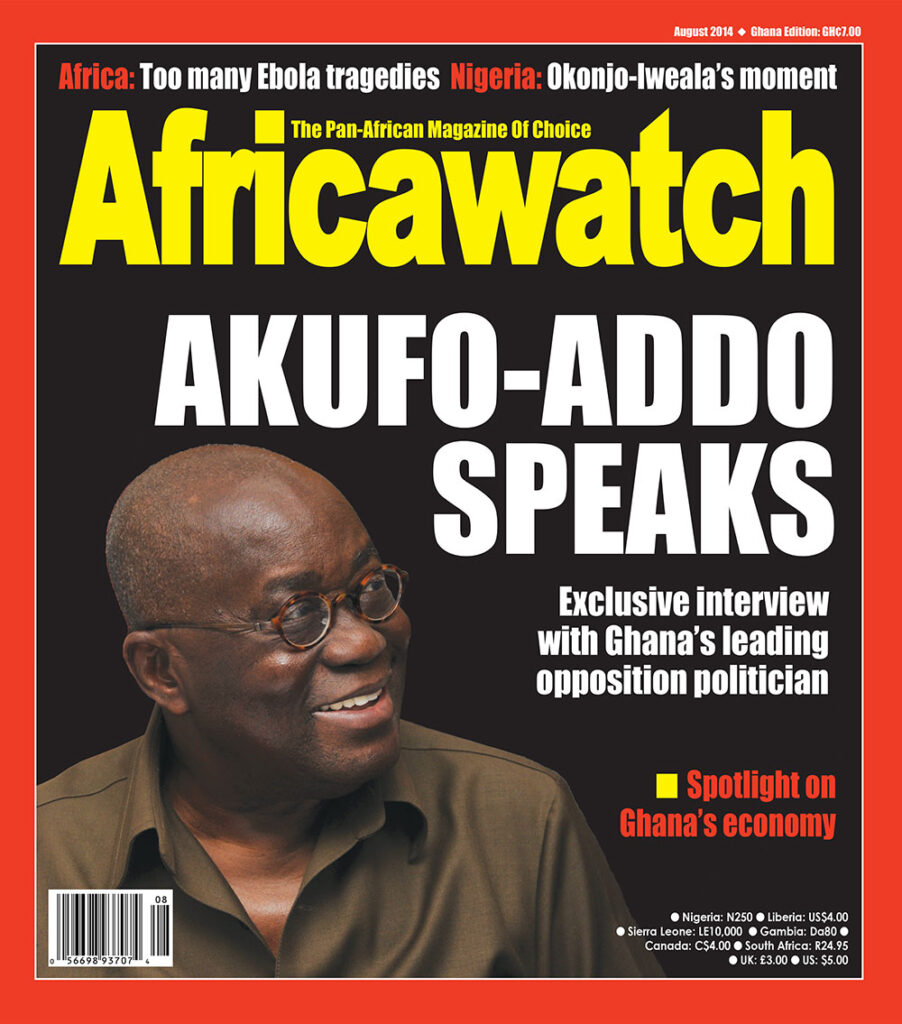
(Published August 2014)
Nana Addo Dankwa Akufo-Addo, who ran for president of Ghana in 2008 and 2012 on the ticket of the New Patriotic Party (NPP), is seeking to lead his party for the third time, in the 2016 elections. Akufo-Addo says his chances of bearing the NPP flag again are very bright. “I am getting support from areas I could only dream of receiving support from in the past. Even more encouraging is the support I am getting from people who admit to never voting NPP,” he tells Africawatch in an exclusive interview. Akufo-Addo is very confident of becoming third time lucky in 2016 because, he says, it appears that whatever Mahama’s government touches turns to dust. “Everything about Ghana appears to be going backwards. No water, no electricity, no petrol, no dollars, no jobs, no mercy!” he claims, and he traces many of the problems the government is facing now to the “unprecedented reckless” spending that the ruling National Democratic Congress (NDC) embarked on in the 2012 elections. “It was a case of breaking the bank in a reckless and desperate attempt to win the general elections,” he charges, and says he prays that “the voters would punish them in 2016.” If he becomes president, Akufo-Addo says, his immediate preoccupation would be for building people’s confidence in the leadership and government of the country.
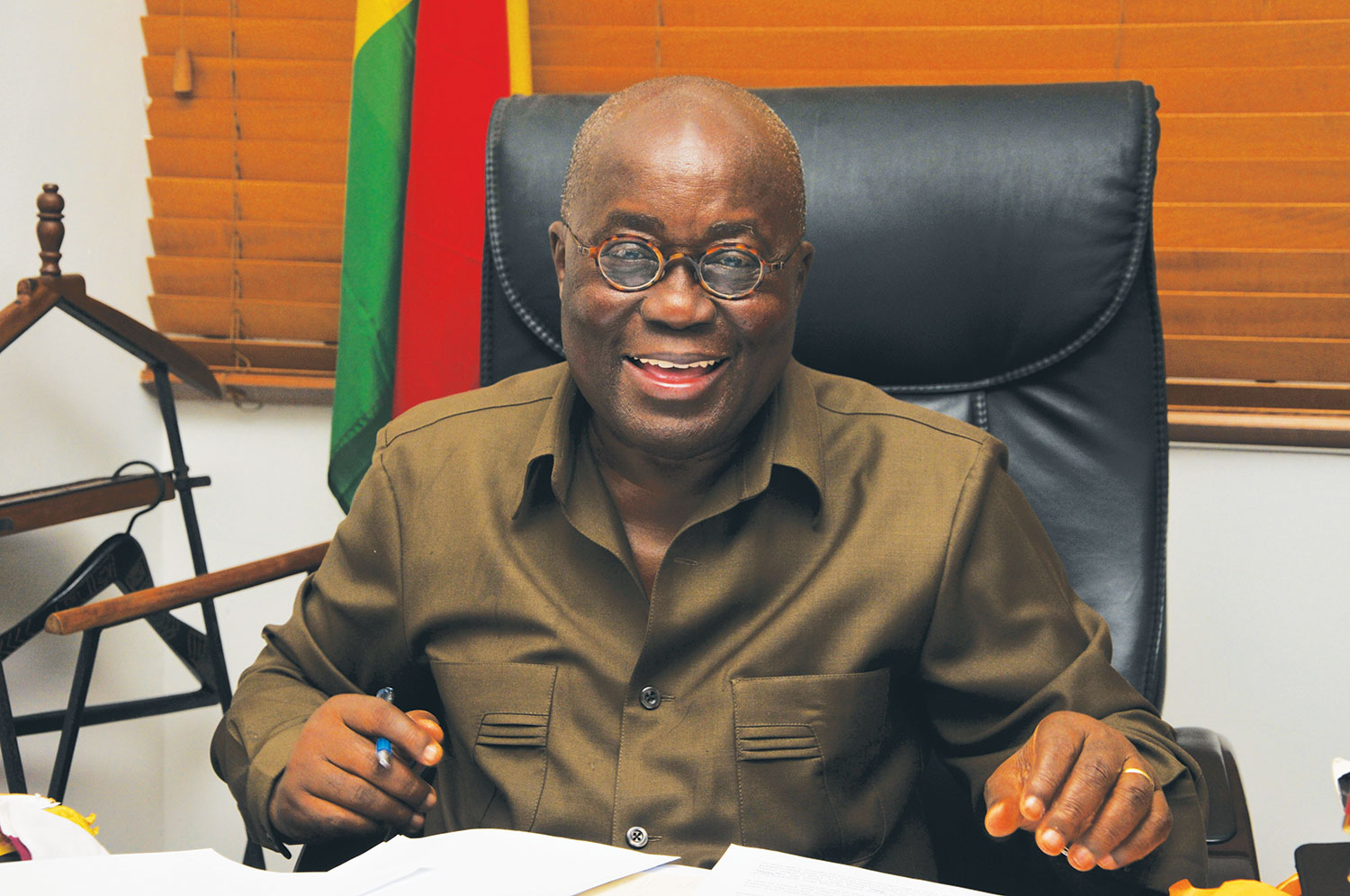
Q: Nana, thank you for inviting us to your beautiful home in Nima.
A: Thank you for coming.
Q: I guess this is your first major interview since you announced in March your intention to seek the Ghanaian presidency for the third time. So there is a lot to talk about. On August 31, your party, the New Patriotic Party (NPP), is holding a Special Electoral College to shortlist five out of seven people for the 2016 presidential nomination. Those who make the short list will then compete on October 18 in the NPP primary. Most political commentators in the country are predicting that you will emerge the winner. But to many others, you have failed twice, in 2008 and 2012, to win the presidency. Shouldn’t you have called it quits after your 2012 defeat? Aren’t you getting too used to losing?
A: The great Winston Churchill said: “Failure is not fatal. It is the courage to continue that counts.” There are several examples of leaders who tripped but kept going and won. Abraham Lincoln, K.A. Busia, Francois Mitterrand, J.A. Kufuor, Mwai Kibaki, Abdoulaye Wade, John Atta-Mills and Michael Sata are all examples of the many leaders who lost more than once before finally winning. I do not consider myself, the NPP or Ghana to be a stranger in this area.
Q: So who really is Nana Akufo-Addo?
A: My simple answer: Nana Addo Dankwa Akufo-Addo is a proud citizen of Ghana. A man who believes in Ghana and in the potential of Ghanaians to build a great nation of a prosperous and caring people at peace with each other. He is a patriot eager to see his country winning. A man who has been around and has seen it all, good and bad days, except one thing – the Ghana that we dream of, pray for and have been struggling to bring into being. I am a proud patriot who has always believed that Ghana can do much better than it has so far done. I want to play a big part in seeing that big dream being fulfilled in our lifetime. I believe right here in Ghana, and among Ghanaians living abroad, we have the people, the brains and the resources to succeed. What we seem to be missing now is the right leadership to put it all together and make the rapid progress we need. To get those things in place calls for the right leadership. I do not believe we have that now.
Q: Do you have what it takes to offer that right leadership?
A: At the risk of sounding immodest, and please do forgive me if I come across as such, I believe I have that can-do, must-do and will-do kind of leadership that can help Ghana fulfill that big dream. So, God willing, and the majority of voters consenting, if given the opportunity in 2016, I am confident that I can assemble a competent and dedicated team to get us there. Ghana must win, and winning is a journey that we must all travel together. But like all journeys, it is the leadership that can give the people the needed confidence to get on board. I hope this explains who I am.
Q: Reading through your biography, you were born and bred in Swalaba and later brought up in Nima, where the masses live in Accra, the capital, and where you still live today. But yours is not a typical Nima house, and you are not seen as one of the masses.
A: This house was built by my parents, and they worked hard for it and passed it on to us. Like all good children must do, we have added our own improvements to it. That is what every generation must do with Ghana, make it better than what was bequeathed by an earlier generation. That is the whole essence of progress. I am not so sure what you mean by I am not seen as one of the masses. I believe that we all share the same dreams. What is important is to create an environment which allows every citizen access to the ladder of a better life. I am not motivated by riches. I am motivated by a desire to enrich the lives of people. I believe the ability to do so offers the greatest sense of fulfillment and happiness any human being can ask for.
Q: That is good to know. If I may quote a bit from your biography, which is available on the Internet: “Nana Akufo-Addo comes from a family where public service is considered a duty and an honor. Born in Accra, his father’s residence, Betty House, in Accra Central, was effectively the headquarters of the country’s first political party, the United Gold Coast Convention (UGCC). Three of the ‘Big Six’ founding fathers of Ghana were Nana’s blood relatives. He attended the Government Boys School and later Rowe Road School (now Kinbu), both in Accra Central. Nana went on to Prep School in England and continued to study for his O-level and A-level examinations. He returned to Ghana to teach at Accra Academy before going to the University of Ghana to study economics. He went back to the UK to study law and to be called to the English bar.” You have had a very privileged upbringing. Does that not get in the way of connecting with the masses?
A: I have noticed that the issue of Akufo-Addo and the masses is important to you. I appreciate that. Am I connecting with the masses? I believe so. I am aware that in politics one has to be working constantly to win more and more people to one’s side. I have been at the forefront of politics, mobilizing people to fight for their political space, defending people and promoting the welfare of people since the 1970s. I could not have done all this if I was not connected to the masses.
Q: With all due respect, the fact is that you were born rich and have never known poverty. Is it not fair to say that you don’t know how the ordinary Ghanaian lives?
A: During the 2008 presidential campaign, I was accused by my main opponent [Prof. John Atta-Mills] of being born with a silver spoon in my mouth. But more Ghanaians found a persuasive enough connection to vote for me on Dec. 7, 2008, rather than him or any of the other candidates. I led in the first round by more than 100,000 votes. Yes, eventually, I lost in the second round by the slimmest of margins, after our party’s parliamentary majority was overturned. I was for 12 years a member of Parliament for a rural community, Abuakwa. Before that, my law firm had built a reputation as the leading chambers in Ghana that had an active policy of giving free legal representation to the poor and needy, who otherwise would have had no access to justice. You cannot be a politician of my experience in Ghana without feeling the heartbeat of the ordinary people. Count back from independence – the leaders that we have had all went to the so-called elite schools in Ghana or abroad: Achimota School, Mfantsipim School, Prempeh College, University of Ghana, University of Oxford, for example. Does that mean they have a natural disconnection with the masses?
I do not know many people in our country who have traveled as extensively as I have, visiting communities that had never even seen their DCEs or MPs before. I believe I have covered more ground than perhaps any other presidential candidate in our constitutional history, listening to the people, their fears and their hopes. And I do so with the view of articulating their issues in our party’s programs to transform Ghana and respond to the welfare and well-being of the people.
Our education and position, as politicians, may be said to put us in a privileged position at the top, but what makes our being there – at the top – legitimate is, in my view, a genuine desire to help make the lives of all Ghanaians better. If that is naïve, then please let me continue to wallow in my naivety. Politics is a serious business because it is about the lives of people. I am in politics because I want to serve. That to me is the essence of politics: a constant and continuous struggle to help improve the lives of people.
Q: Do you think that you have somehow become a victim of your parent’s success?
A: I must admit, I think one of the things that I have learned to live with is that my opponents have been ruthless in making me a victim of my parents’ success and, perhaps, my own success in life. I do not see it as a positive attitude to make people who have achieved legitimate success feel bad. I am proud of what my parents achieved and what they did for me, and I am proud of what I have done in my life and what I have done for my children. What agitates me is the fact that there are many parents out there, who, through no fault of their own, cannot afford to offer the basic essentials of parenting to their children. A society that allows such a situation to prevail is a society that has lost focus. What matters to me is how we can build a society where the opportunities that people like me had are open to every hardworking and caring family.
Yes, I know I was lucky as a child to have parents who gave me a good start with education, especially. I know what education did for my father. I know what education has done for me. And, I think one of the greatest tragedies is being born into a society that does not give every child a fair opportunity to get a good start in life. I am convinced that it is doable to turn Ghana into a society of opportunities. That is why I am so keen on education.
To me, access to free, quality education is a duty that no government must compromise. There is enough evidence in my own extended family, in our country and across the world to tell us that the greatest gift we can give to our children and the future of society is education. Pure and simple.
Q: What do you make of what President John Mahama said in his State of the Nation Address, delivered to Parliament on Feb. 25, by promising to introduce free secondary school education into Ghana by 2015. This was your major campaign promise in both 2008 and 2012, and the ruling government described it as almost impossible. Some say Mahama has stolen your 2016 thunder. What do you say?
A: I was very happy to hear the news that the government has finally come around to the idea that the cost of secondary education was killing parents, and, thus, keeping many children out of school. It is nothing new with this government to dismiss ideas from opponents during campaigns and yet rush to adopt or implement them once in office. More worrying for me is that they have a record of bungling the implementation of these policies after making a U-turn to embrace them. They did it with our Northern Development Authority idea, where we proposed to raise a billion dollars for investment into strategic areas in the north so as to initiate the process for bridging the development gap between the northern and the southern parts of our country. They quickly tried to copy and implement the idea by introducing SADA (Savannah Accelerated Development Authority), which has sadly turned out to be an apology of an intervention. It has been bedeviled with extensive corruption and over inflation of contract sums, and nothing to show for all the expenses made. Stealing the idea is not the problem, because then it means the idea is good. Stealing it and not having to think it through because it’s not an original idea is the problem, for it leads to corruption and more poverty and underdevelopment for the people.
Unfortunately, one cannot even say they have stolen our thunder, because they are not going to translate the idea into reality. I would be happy if they could, because free SHS is not a propaganda concept or a slogan coined to win an election; it is what we need to do to start the transformation of our economy and our society. Again, I believe what they have in mind is just a watered-down version of what we intend doing. Our policy would capture not just day students, but boarding students as well, because more of our secondary students are in boarding schools, and that is where the cost is most unbearable for the parents.
Given the current state of the economy, my concern is that the government’s main interest is the next election, and so it may not properly think through the idea; hence money will be spent but the objectives not achieved. That would be most unfortunate and unhelpful to our quest for development and the need to prepare our children for the future.
Q: So, if elected to lead your party again in 2016, would you bring back free SHS?
A: What I believe to be true about me is that I am consistent and sincere in what I think to be right for our nation. In 2012, we improved the details of the free SHS concept. For 2016 – if, God willing, I am elected to lead my party – you can be sure that we will look at the policy, look at what has been achieved in education, look at the overall state of the economy and tailor the content of the free-SHS program accordingly. What is absolute is that the difficulties that inspired the free-SHS manifesto pledge are still with us today and that free-SHS may be even more urgent and relevant today than in 2012.
Q: In announcing to the public on Aug. 29, 2007, why you wanted to be president, you said, among other things, “I come from a background where public service is considered a duty, and where privilege and good fortune demand even greater commitment to the common good. Generations of my forebears and relations established this rich tradition of public service, of which I am proud and which has been the source of constant inspiration.” Looking at your biography, you have devoted close to four decades of your life to public service. What drives Nana Akufo-Addo?
A: I think that statement you just quoted is a good starting point as to what drives me. As I also said on that day in 2007, my experience in life has helped me to be fully aware of the responsibility the job of leader brings. I consider myself fortunate enough to carry a sense of the history and struggles of our country as well as of the challenges and opportunities of the future. Crucial to this future is how to unleash energies to broaden the horizon and to realize the hopes of every man, woman and child in Ghana.
I was 4 years old when the Feb. 28 riots took place in 1948. And, even at that early age, the heightened activities in our family home, Betty House, brought it home to me that my father, William Ofori-Atta, Dr. J.B Danquah, Obetsebi Lamptey, Kwame Nkrumah and the others were involved in something immensely important.
I remember thinking to myself then that whatever it is that they were doing, I wanted to be part of it. I think that effectively sowed the seeds of public service in me.
Another equally important event was when Dr. Danquah was released from detention under the Preventive Detention Act in June 1962. There was celebration in my family. I was 18 at the time. My mum and aunties had failed to convince Dr. Danquah to take a break from politics and go into exile, as they feared for his life. I, obediently, went to him to convince him to leave the country for some time. His response had a firm and permanent impression on me. He said he could not leave the frontline. He had to stay to keep the dying flames of freedom burning, and he would stay even at the risk of losing his liberty or his life.
The passion, the selflessness, the patriotism and the principled stance of those great politicians of the independence struggle defined for me what politics was all about. They were driven by a great sense of optimism that we could build right here in Ghana a free, modern and prosperous society of opportunities for every citizen, regardless of the circumstances of birth. I saw right then that what separated them from many others was: 1) that they had access to education, and 2) they were determined to change the circumstances of their country and all of its people for the better. This is what has been driving me ever since. I am an incurable optimist when it comes to what Ghana can be and the capacity of the Ghanaian to make it happen. The people are ready. It is up to the leadership to inspire us to get there. That is my belief.
Q: Talking of exile, it is reported that you went into exile on two occasions. Is that right?
A: Yes, that’s right. I was in exile after the People’s Movement for Freedom and Justice (PMFJ) agitations in 1977-78 against General Acheampong’s push to consolidate his military dictatorship. But only for a short while, and came back when General Acheampong’s government was overthrown. I was forced to stay in exile again when the Provisional National Defense Council (PNDC) overthrew the Third Republican Constitution and the three judges were abducted and murdered. I was away in England for a short visit at the time.
Q: With the PMFJ, we all know you were the general secretary of that movement. But what was your link with the judges’ murder, if any?
A: During the Limann administration, in the short-lived constitutional era of the Third Republic, I was one of the lawyers who challenged some of the decisions of the Armed Forces Revolutionary Council (AFRC) in court. I succeeded in securing, before Justice Cecilia Koranteng-Addow, the freedom of Lloyd Shackleford, who was unlawfully detained. I was successful in suing for the return of the assets of J.C. Akosa of Tip Toe fame before Justice Kwadwo Agyei Agyepong.
Q: According to the records of the National Reconciliation Commission, the three justices were abducted and murdered for their roles in the reversal of AFRC cases. So you had something to do with it?
A: I had something to do with defending the rights of Ghanaians against arbitrariness. I have always stood up in defense of human rights.
Q: But it appears that apart from academic purposes, the longest you have stayed overseas was when you worked with a law firm in France in the early 1970s.
A: After I was called to the bar in England, my dad and I felt gaining some corporate culture in the West would be useful. I was also fully aware that Ghana’s three borders are shared with three French-speaking countries. I even suspect the Gulf of Guinea may be more French speaking than English. I was also impressed by the determined efforts of Germany, France and the Benelux countries who share common borders to integrate their economies through the then-European Economic Community. So I was fortunate enough to spend five years in Paris working for the international U.S. law firm, Coudert Freres, and learning to speak French. This experience helped my development as a corporate lawyer and helped my law practice in the West African region. As you know, French is a very useful tool in business and diplomacy in Africa. So it came in extremely handy during my tenure as foreign minister, and I believe it is a tool which, God willing, will help me if I am voted to lead Ghana. I consider the integration project as critical to the future of our country, our region and our continent.
Q: But, surely after two defeats, and the painful 5:4 split decision that you suffered at the Supreme Court last year, you might have felt like giving it all up?
A: I am very human, and I had to consider whether to continue or not. But after deep reflection, communing with my God, the entreaties of many people in and outside the country, the support of my wife, Rebecca, and my children, I realized that there is still fire in my belly, and the charcoal that keeps the fire burning is my deep attachment to the vision of a free, open, prosperous, self-reliant Ghana that is at the heart of the Danquah-Dombo-Busia political tradition. The decision to run for a third time was not one that I took alone. I was also inspired by how our party came out of the last election, and the election petition last year, with the enthusiasm to work harder to secure victory in 2016. It reminds me of the inspirational words of Maya Angelou: “You may encounter defeats, but you must not be defeated.” The NPP is not a party that feels defeated. And I do not feel defeated. Like the vast majority of the NPP, I feel that we failed to secure a victory declaration in 2012. And we are determined to have done what needs to be done between now and December 2016 so that we can maintain the confidence of the Ghanaian people, get their votes again and this time protect their votes to the point of declaration. And once that is achieved, God knows, we will do something very positive with the power.
Q: Former President John Kufuor told your party supporters in London recently that the NPP’s forefathers taught the party what to do with power and that for the others, they know how to get power and not what to do with it once they get it. Is that a fair description of the NPP and NDC?
A: I think it is an interesting observation. Before the 2000 elections, a leading official of the NDC described the party as little more than a machinery built for elections. I am in full agreement with President Kufuor that we know what to do with power, which is to serve and serve right, with the people’s mandate. We showed our intentions during Prime Minister Busia’s short time in office. And, we showed what we are capable of during President Kufuor’s eight years in office. We made a good case that we are the party with the capacity to advance Ghana’s development. It is important to remember that out of Ghana’s 57 years of independence, our political tradition has only been in office 10 and a half years. By the next election, the (P)NDC would have had 26 out of the last 34 years alone. The question is, what have they done with it? It may be fair to say that our forefathers did not teach the NPP to rig elections, because we do not believe in tampering with the mandate of the people. I believe what the whole country saw with the evidence we provided in court last year was that we need to do a lot more work, as a party, to protect the votes, and we need to do a lot more work, as a nation, to enhance the integrity of the electoral system. I also believe the difference between the two main parties in Ghana today, the NPP and the NDC, is as clear as day and night to every Ghanaian.
Q: What are your chances of you winning this time?
A: Very bright. I have been greatly moved by the words of encouragement and support that I keep getting across the party from people who admit they didn’t vote for me in the last NPP congress. I am getting support from areas I could only dream of receiving support from in the past. Even more encouraging is the support I am getting from people who admit to never voting NPP.
Q: If you win the NPP presidential nomination, you are likely to lead a very divided party. Everywhere you go, your party sympathizers express worry and frustration over the internal bickering in the NPP – talk of the Kufuor/Mpiani/Alan camp versus the Akufo-Addo camp. NPP appears not ready for power. Disunity cannot win you the election.
A: NPP not united? I think the opposite is really the case. I believe the NPP is united today more than ever. I have been at the center of this party right from the beginning, in 1992, and I must say that I have never seen it as united as it is now. What we are going through is not unusual. There is a contest to elect the next presidential candidate. Every candidate and his supporters are trying their very best to show why it should be them and not the others. This is natural in competition. What matters is that we do not inflict any hard-to-heal wounds on each other. I believe that is something that the party leadership is concerned about, and it is my hope and prayer that all of us will do our very best to keep it clean and decent.
Q: What about the Kufuor factor?
A: I think we should try as much as possible to leave President Kufuor out of this. He is not a contestant and cannot be. The Kufuor factor is a great asset for us against the NDC. Especially in this era of major economic mismanagement, the Kufuor factor, as I understand it, is his record of superior competence in managing the affairs of the state.
Q: But it seems Kufuor does not support you.
A: President Kufuor has given me his fullest support in each of the two presidential contests that I have led the party. And, God willing, if I am elected once again to lead the party in 2016, I know that I can once again count on his full support. I think attempts to drag the former president into the fray are unfortunate. He has served his two terms and did so successfully. I do not see what would please him more than seeing NPP back in office, and I have no doubt that he will do whatever he can to help us win a famous victory in 2016. My focus now is to run the kind of campaign that will allow the party to rally its forces together after the primaries. I do not want to give any party member any legitimate reason to hold back his support for the 2016 contest. We need all on board.
Q: You have run for president twice and lost on both occasions. What makes you think that you will be successful in 2016 if you win the NPP presidential nomination?
A: There is nothing that says I will not be successful because it is my third attempt. Indeed, history is replete with several instances where people made several attempts at their country’s presidency or other positions in life, and some succeeded the initial attempt, others, second, third and even some fourth attempts. In our country, I lost to the late Prof. John Atta Mills in 2008, in his third consecutive attempt.
I believe my vision for Ghana is still very relevant. My supporters and many more persons have expressed even greater belief in me and my vision. My passion is intact. I am in sound health: emotionally, mentally, physically and spiritually.
I get a sense the 2000 atmosphere that swept away the then seemingly indomitable (P)NDC is coming back. But, we cannot afford to be complacent and think that disappointments with the government will necessarily translate into votes for the NPP. Furthermore, we cannot be equally complacent and expect that the votes that we will get will necessarily translate into the votes that will be declared for us. It is our job to make sure that the processes that will enhance the diligence of our agents and the integrity of the electoral system are in place.
Q: You sound as if you believe the 2012 election was stolen from you.
A: I will not go beyond the evidence that was presented in court and the decision that was read in court and my response to it on that day, Aug. 29, 2013. Yes, I expressed disagreement with the court’s decision, even though I accepted it, and I still stand by it. I believe the whole nation is our witness.
Like I said, I was saddened by the verdict, just as many of our supporters were. However, at every point in time you have to weigh which of the options available to you will be in the best interest of your country. We decided to end the matter there for the sake and love of our country. Ghana has to live for us to live to fight another day. Many people who now have the benefit of reading the complete ruling think I should have asked for a review, especially looking at the inconsistencies and arithmetic flaws therein, coupled with the problems and economic situation that we find ourselves in. But I still think that I was right that I made the decision that it was time to move on after eight months of court hearings.
If I may stress, thanks to the trial – which was shown live on television – the weaknesses in our electoral process have been exposed to the whole nation. Public education has been enhanced. We must now focus on what to do to reform the electoral process to enhance public confidence in the electoral system and protect the integrity of our democracy.
Q: You are on record promising your party supporters that you will not lead them back to court after the 2016 polls. Isn’t that scary? We have all seen the violence in some African countries after disputed elections. Are you not worried about the prospect of another disputed election in 2016?
A: I am worried. Very worried. But the good news is that we do not have to wait for an opportunity to pick up the pieces. I believe we must be proactive as a nation and take measures to address the concerns that feed the threat. The NPP will make the issue of electoral reforms a major preoccupation as part of our preparations for 2016. We heard the chairman of the Electoral Commission (EC) saying that there was nothing wrong with the voters’ register in response to demands for an independent forensic audit, as requested by some political parties and civil-society groups. It is difficult to appreciate why the EC would want to take such a hard-line position against calls for an independent audit. It is potentially dangerous, because the last thing Ghana wants is to approach the 2016 general elections with a thick cloud of suspicion over the base document for the polls. I think the issue of Ghana’s discredited voters’ register cannot be brushed aside. I hope the Commission will change its position on this. Taking hard-line positions is not the way to go.
Q: You recently said Ghana is in an era of retrogression? Is that not an exaggeration?
A: No. Go out there and talk to the people. Everything about Ghana appears to be going backwards. You may look at the problems we are facing now and say we have seen it all before. But I have been around for some time now, and I don’t remember the last time we had all these problems hitting us at the same time. No water, no electricity, no petrol, no dollars, no jobs, no mercy! It appears whatever Mahama’s government touches turns to dust. Even when they try to fix the falling cedi they end up making it worse. The cedi depreciation was worse in the four months after February when the new exchange rules were brought in than the previous four months. Moody’s, one of the major credit-rating agencies, was the last agency to give a negative outlook to our economy, downgrading Ghana from B1 to B2. What it means is that Ghana will now pay more in interest rates for borrowing as government returns to the international bond market for some $1.5 billion.
Q: The government says it is facing economic challenges and not crisis.
A: The truth of the matter is that the economy is in crisis, and government is finding the work of dealing with the crisis most challenging. So, I believe that is what they mean by saying they are facing challenges.
There is a saying in Twi, the Akan language, that if your mother just passed away and you tell your household that she’s only taking a nap, you would have to eventually deal with the stench, if you like. It is not what opponents or critics of the government say that is important. What is important is the situation on the ground. A bag of cement that was selling at GH¢25 a month ago is now selling at GH¢35.
Just last week, I met with a small group of chop bar owners. As you know, these restaurants cater more for the ordinary people because of affordability. Their complaint is that business is bad. It is a good enough indication of how bad things are. Their problem is that they are forced to lay off workers and ration the quantity of food they sell because the only other option, which is even less palatable, is to pass on the constant rise in cost of production to their already struggling customers. You can say that the crisis is so bad that the nutritional intake of the average Ghanaian is suffering. They complain that a box of frozen chicken which was selling at GH¢45 in April is now selling at GH¢80. A box of six tinned tomatoes which was selling at GH¢48 in April, is now going for GH¢72. A bag of 50 kilograms of rice, which was sold for GH¢190 in April will now set you back GH¢240. A container of 25 liters of cooking oil which was selling at GH¢75 in April will now make a GH¢125 hole in the budget of a chop bar owner.
Q: But it seems the government is very optimistic.
A: Ghana, sadly, is governed by a group of politicians who are experts in giving the impression that what matters in governance is propaganda and not substance. And, as far as substance is concerned, what matters is the competitive weight of their propaganda as opposed to that of their adversaries. I see it as a cynical view of politics and one that is insulting to the intelligence of the people and insensitive to their real concerns. Yes, the government is facing challenges, precipitated by economic crisis, a crisis Ghana could have easily avoided.
Q: Are you not at risk of talking down the economy?
A: I think the greater concern should be about those talking down the problem. I do not see how one can deal sufficiently with a problem when one is not prepared to admit that there is, indeed, a problem.
Q: The government is saying the inflows which it expected to get from donor countries have not come in, and that has aggravated the fiscal constraints.
A: Ask yourself, why? Our development partners are also accountable to their taxpayers. They are entitled to satisfy themselves that the money they give us is spent prudently. They are, I believe, as puzzled as we are at the kind of reckless spending that has taken place in recent years. I will hope that they will reconsider the plight of the Ghanaian and make good their funding pledges to our government. But on one important condition, though – that they demand and ensure proper accountability on how every pesewa is spent by the government. The NPP managed to convince our development partners to change their funding method to the multi-donor budget-support program, which allows the government a greater level of flexibility on what it chooses to spend the grants received on. But, I am not so sure this government has done enough to show that it can be trusted with a similar kind of flexibility. It cannot continue taking grants and borrowing money in our name and not spending it for our benefit, giving us value for money.
Q: The government also says the implementation of the Single Spine Salary Structure (SSSS) has created problems, because after the salaries of public-sector workers are paid, there is nothing left in the kitty to fund capital expenditure and other recurrent expenditure items …
A: I think that is an embarrassing admission which further exposes the fact that this was a government that was operating without a plan. I believe every manager of a small business knows that before you make a commitment you must project how you are going to pay for it. Are they saying this was not done? I also believe that if the economy was managed properly, and the growth sectors of the economy were given the needed support, and public procurements were done on value-for-money basis, government would have had no business complaining about the cost of the SSSS. The wage burden as a proportion of revenues has not changed that much. What has changed is the propensity of this government to spend recklessly on non-priority areas and pile up arrears. Sweeping your responsibilities under the carpet does not make them go away. You only risk choking on the dust it accumulates.
Q: So what do you see as the main cause of the crisis that the economy is facing?
A: I will say, in short, the current economic crisis in Ghana was caused by chronic recklessness. Reckless borrowing, reckless spending, reckless awarding of contracts, reckless pricing of contract sums, reckless payment of judgment debts, and the overall application of the kind of incompetent economic management that can only be described as inherently reckless. How many times did we, the opposition, not warn them before 2012 of the mad rush for loans? Wasn’t it strange that in five years a government managed to increase the country’s debt from around $8 billion to $24 billion? And we thought the chickens would be happy not to come home to roost? I remember making the point in 2012 that the NDC government had spent more in four years than what the NPP had spent in eight years, and I wondered what they had done with all that money. On hindsight, I was even charitable.
It is just too sad. By 2009, after that smooth transition from the Kufuor government to the Mills government, and as the country was preparing for its first oil production, investors were excited about our country’s prospects and were willing to take a chance with us. It was obvious to us, in opposition, that the NDC was prepared only to win power and not for office. The decision to sign an agreement with STX, a Korean company known for building ships, to build 200,000 homes in Ghana at the cost of $10 billion and for our government to pay $4.5 billion in advance, as part of the off-taker agreement, was the clearest indication to us that the NDC came into office with no proper plan for Ghana’s development. Tellingly, that shocking housing deal was led by the then vice president, John Mahama, who is now the president of the Republic. So it has been difficult for some of us to have any greater confidence in his leadership than in that of his predecessor. Since then, we have seen his government stumbling from one disaster to the other.
Q: What do you think about the government’s decision to access only half of the $3 billion facility from the China Development Bank and the tussle between the two?
A: Yes, it was obvious to us that government had not done its work on the details of the loan agreement. The costing was poorly done. We warned that the facility was too expensive and there was no guarantee that we would get the full value of the $3 billion. It took government three years to wake up to our concerns. I find that level of stubbornness hard to believe. Now we are told government is no longer pursuing a chunk of that facility. That has been the story of this government. We have spent close to $20 billion on supposedly major projects since the NDC took over in 2009, and with very little tangible projects to show for all that money. A government that came into office with a plan would have started off by looking at the list of infrastructural priorities the country needs, which must include roads, railways, electricity, water, irrigation, housing and ICT. For each of these projects, a well-planned straight $3-5 billion investment could have made a transformational difference over the period. Instead, we have spent a lot more than that, and we continue to struggle with the same problems, as the pace of development struggles to keep up with population growth. I am sad. I am sad about the opportunities that we have missed as a nation. I am sad about the international goodwill that we have squandered. I am sad about the economic and social improvements that we could have made in the lives of the people with half of the amount of money that was spent, if only it was spent wisely.
Q: The Ghana cedi, what is happening to it?
A: That is a good question. Let me try and illustrate how dire the situation is. In the last 18 months alone, the cedi has fallen faster than it did in the entire eight years of the NPP. It has won the unfortunate accolade as not only the worst-performing currency in Africa, but the second worst in the world. Only doing better than Ukraine’s local currency, the hryvnia, and we all know that Ukraine is today a conflict zone.
Q: What is your view of how the Central Bank is managing the crisis?
A: I think part of the problem is that there is very little or no confidence in those setting both monetary policy and fiscal policy for Ghana. The central bank is, of course, struggling to manage a crisis caused by government’s recklessness. But it played a big part in the crisis when in February it introduced foreign-exchange regulations that ended up worsening the crisis. It is obvious that it is difficult to recapture confidence when your measures brought in to resolve a particular crisis end up deepening the crisis, compelling you eventually to backtrack. That has been the story of this era of retrogression. The authorities do not like to heed to advice and will proceed until they get their nose bloodied after hitting the wall, causing needless injury to the resources of the country in the process. So, part of the problem is that huge confidence deficit in the capacity of the people tasked to manage Ghana’s economy. These intangibles are delicate valuables that one must have in order to earn the confidence of both business and consumers. I am hoping the government can pull out of this mess. NPP does not need the NDC to fail miserably to show we can do better. I worry about the impact of this level of incompetence and recklessness on the livelihoods of ordinary people. There is still a long way to go to the next election, people cannot continue suffering until the opportunity to change government comes in December 2016. Something must be done now by the current custodians of the national purse to bring relief. Frankly, the signs are so far not positive.
Q: So what would an Akufo-Addo government do differently?
A: First, an Akufo-Addo government would not go to the villages telling people that things are better now because, as a result of good economic management, recipients of money transfers are getting more cedis for their dollars sent from their relatives abroad. That is the propaganda twist being put out there for the sliding cedi against major currencies.
I know, God willing, an Akufo-Addo government would have the men and women with the requisite competence to bring back the needed confidence in the economy. That is key. When there is confidence in your capacity to manage an economy, it is a good foundation for managing it. Your task is to then put in place the programs and measures to justify that confidence and build on it. We have to admit there is too much fiscal indiscipline in the administration of state funds, which must be addressed at all levels of our governance. Value-for-money considerations in the award of contracts and procurements are constantly overlooked. An Akufo-Addo government would make value for money an uncompromising policy. We will do so by allowing the system to work. I believe we have enough rules and regulations to demand and receive value for money.
What is required is the leadership discipline. I want to lead a government where rules are obeyed and enforced, and there are rewards for doing the right thing and penalties for doing what you know to be wrong. Countries that do well are countries where rules work. We must make the rules and regulations that we set for ourselves in Ghana work. The cost of disobedience is heavy, as it is that which feeds corruption and waste, which ends up affecting the quality of public service that a government can give.
Q: How does this explain the kind of fiscal straitjacket the government is in now?
A: I know many observers find it puzzling, but you can trace much of the problems government is facing now to the unprecedented reckless spending that the NDC embarked on in 2012. It was a case of breaking the bank in a reckless and desperate attempt to win the general elections. I must admit, I did not think any government could be that reckless in abusing the public purse to perpetuate itself in office. It was truly irresponsible. I pray that the voters would punish them in 2016 and, hopefully, by that send a strong signal to all politicians that the people would no longer tolerate such behavior. Since then, the NDC government has been struggling to close that 11.5 percent or so fiscal deficit of 2012. And in the process, many essential projects are being starved of funding. Our roads are suffering; education funding has suffered. The health sector is in crisis; developments in the districts are at a standstill. There is simply nothing left, once the cost of recklessness takes its toll. This is not the way to manage your home budget, let alone that of an entire nation. Simply awful!
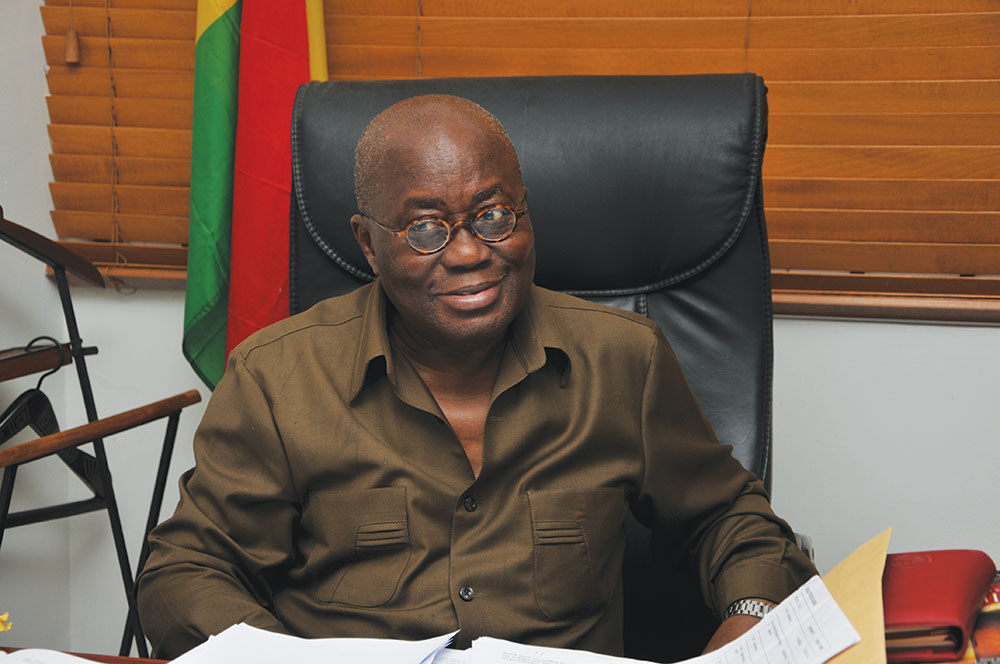
Q: So what would you advise?
A: There should be a critical requirement by governments of a commitment to fiscal discipline beyond the electoral cycle, but question is: Are we as a people and politicians alike willing to abide by this discipline, regardless of the impact on our electoral fortunes? The passage and enforcement of a Fiscal Responsibility Act will be important in this regard, supported by political will. This law will require governments to declare and commit to a fiscal policy that can be monitored. It will include fiscal rules (including rules governing election-year spending), provisions for transparency and sanctions (including sanctions on the executive). It would mean, for example, that governments cannot by law spend above a certain limit relative to revenues. Fiscal indiscipline and the resulting fiscal excesses are ultimately paid for by ordinary citizens who have no place at the decision-making table of the politicians.
Again, formalizing the informal sector to expand the tax net through a national ID and house-numbering system is a must if we are to get serious with improved revenue mobilization. We also have to make the laws work so far as deterring corrupt acts.
I also want government to engage stakeholders to debate whether the exchange-rate regime that we are operating is optimal or whether we should move towards a currency-board arrangement like Hong Kong, and live with the discipline that would entail.
I will go back to what I believe should be the overarching policy preoccupation of government, in collaboration with the private sector, which is to transform the structure of the Ghanaian economy.
Bottom line, what Ghana needs and deserves is a government that thinks more about the next generation than the next election.
Q: If you become president in the 2016 election, what will be your government’s immediate priorities?
A: My immediate preoccupation would be to build confidence of our people in the leadership and government of Ghana. We face a dangerous situation of a significant loss of confidence in our government and national institutions.
This has come about because of perceived widespread corruption and the irresponsible habit of making wild promises that are not and cannot be redeemed. It would mean sending out a clear message to the nation that it is not business as usual with government officials being reckless with state funds. Important decisions will have to be taken, and they can only be taken when you have the confidence of the people. Transparency will be a watchword, because we shall need to carry the population with us in all we do.
Creating jobs will be a major priority and, in partnership with business, government will make the transformation of our economy to enhance its capacity to create a large pool of value-adding jobs its business. I still maintain that we cannot continue to be a raw-material-producing economy if we want to fund all the wonderful ideas and dreams that we want to bequeath our children. We must begin to process and industrialize, and this cannot take place in the current environment where there is unreliable power.
At the center of this transformation agenda is a comprehensive development of the agribusiness value chain. First, we must address our energy challenge as an emergency. We cannot modernize without access to reliable supply of power. We will seek to reduce the cost of doing business, as the cost of credit is currently unbearable. My program to ensure that every Ghanaian child gains access to free, quality education from preschool to secondary will be pursued vigorously. Affordable housing is also a major socio-economic priority, which I believe can be achieved with a housing policy that actively encourages the private sector to focus more investment attention on building decent homes for ordinary workers and families. I believe we can make it make commercial sense and still serve an important social good.
But to be able to do all these, the fundamental public-spending principle of my government will be to give value for money. That is one thing we cannot compromise on if we are to succeed. I am convinced we can achieve a lot more even with the limited resources we have.
I will also restore Ghana’s image and preeminent position in Africa. Today, the only way to give Ghana a strong voice on the international stage is to make Ghana work at home. Good governance, a peaceful and united country and a strong economy would be the best way to sell Ghana, and that would ensure that we have a strong voice in Africa and in the world. When we are strong at home, we set a good example for other African countries to emulate and our voice will be heard loudly on the international stage. Also, I believe strongly in the regional integration project, because it makes sense for Ghana, it makes sense for West Africa and it makes sense for Africa and our ability to be competitive globally. I see the regional agenda to integrate our economies as necessary to the national agenda to build a free, prosperous Ghana of opportunities for every citizen.
Nana, thank you for your time.