
Rising oil prices due to the conflict involving the U.S., Israel, and Iran are a concern for inflation across Africa. The conflict has effectively closed the Strait of Hormuz, a crucial passage for one-fifth of the world’s oil. Some oil producers, like Angola and Libya, may benefit from the high prices, but this advantage could be offset in countries that need to import refined petroleum products, such as Ghana and Nigeria. Allan Olingo reports.
Surging oil prices triggered by the war with Iran are rippling across African economies, threatening higher fuel costs, rising inflation and renewed pressure on currencies across the continent. Africa imports most of the petroleum products it consumes, leaving many economies highly vulnerable to supply disruptions tied to tensions in the Middle East. “Africa is a net importer of oil products, meaning it is heavily exposed to shocks like these,” said Nick Hedley, an energy-transition research analyst at Zero Carbon Analytics.
When global oil supplies tighten, Hedley said, prices rise while African currencies often weaken, as investors move funds into safe-haven assets such as the U.S. dollar.
That combination amplifies the impact of price spikes in import-dependent markets such as Kenya and Ghana.
A similar dynamic unfolded after Russia’s invasion of Ukraine in 2022, when rising crude-oil prices and a weakening currency pushed transport-fuel prices in South Africa up by more than 25% within six months, Hedley said.
“The near-term risks come from mainly the rising oil prices and weakening exchange rates as investors move to safe-haven assets,” said Oxford Economics senior economist Brendon Verster.
Oil markets remain particularly sensitive to the conflict because of the strategic importance of the Strait of Hormuz, a narrow shipping corridor through which about a fifth of the world’s crude passes. Ship traffic in the 21-mile strait, which connects the Persian Gulf nations to the ocean, fell by 90% within a week after the U.S. and Israel attacked Iran on Feb. 28, and Iran retaliated by attacking tankers and other vessels.
The impact of higher oil prices across Africa will be uneven.
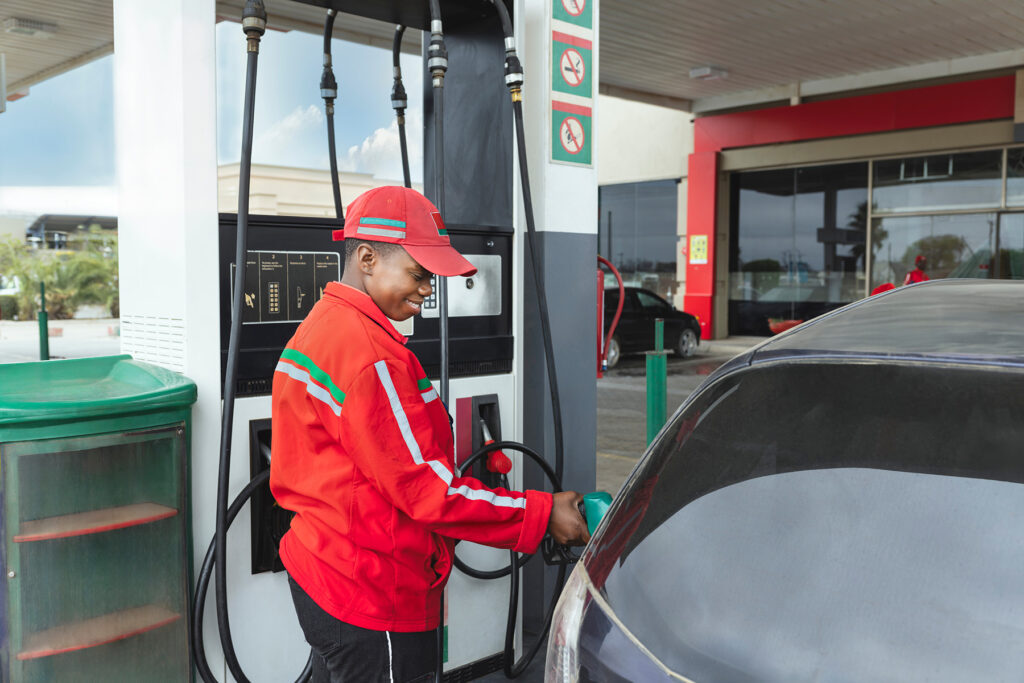
Countries like Kenya and Uganda say their supplies remain stable even as they work on ensuring continuity. Nigeria and Ghana produce crude oil, but import most of their refined petroleum products, limiting the benefits to them of higher global prices.
“It’s difficult to say at this point whether they will see net gains,” Hedley said. “Oil producers could benefit from higher crude prices, but ordinary citizens will likely face higher transport and fuel costs, and potentially higher interest rates.”
Still, sustained high prices could bring a windfall for Africa’s major oil exporters. Verster noted that Nigeria exports roughly 1.5 million barrels of oil per day and has based its medium-term fiscal framework on oil prices between $64 and $66 per barrel through 2028.
The war pushed prices above $100 per barrel on March 9, a level that if sustained, would significantly boost revenues for exporters including Angola, Algeria, and Libya.
Serious concern
For most African households, however, the immediate effect is likely to be higher living costs.
“This is a serious concern,” Hedley said, noting that most food and goods across Africa are transported by road. “Rising fuel costs therefore feed quickly into broader inflation and reduce household purchasing power.”
Peter Attard Montalto, managing director at the South African advisory firm Kruthan, also said the crisis will test African economies.
“So far the impact has really been muted, for countries like South Africa,” he said, noting that recent economic reforms have helped stabilize the country’s currency and bond markets. “Still, higher oil and gas prices are expected to filter into inflation in the coming months.”
Over the longer term, analysts say the crisis may reinforce calls for African nations to diversify their energy systems and reduce dependence on imported fuels.
“It makes strategic sense for African countries to ensure long-term energy security and sovereignty,” said Kennedy Mbeva, a research associate at the Center for the Study of Existential Risk at the University of Cambridge.
Achieving that, Mbeva said, will require balancing short-term fiscal pressures with long-term investments in clean energy and green industrialization.