
Much of the international community, particularly countries in Africa and the Middle East, has criticized Israel’s recognition of Somaliland, a breakaway region of Somalia, as an independent nation. Some express concerns that this decision may exacerbate instability in Somalia, which is already facing significant challenges, and argue that it contradicts global standards of respecting countries’ territorial integrity. In response to the widespread criticism, Israel stated that it will determine its own diplomatic relations without outside influence. And now that Somaliland has gained recognition without fulfilling the usual procedural requirements, the question shifts from “why Somaliland?” to “why not elsewhere?” Lesley Anne Warner reports.
Israeli Prime Minister Benjamin Netanyahu triggered a global outcry in late December when he announced the establishment of full diplomatic relations with the breakaway republic of Somaliland in northwestern Somalia. Within 48 hours, the African Union and the East African regional bloc that includes Somalia, the Intergovernmental Authority on Development, issued condemnations. Twenty African and Middle Eastern nations signed a joint statement denouncing the “illegal recognition.” The Arab League convened an emergency session in response, and Somalia, currently serving as a nonpermanent member of the United Nations Security Council, quickly secured an emergency meeting of the council, where most of its members – with the exception of the United States – spoke out against the move.
Somaliland declared independence in 1990 and functions as a de facto state, but until Israel’s announcement, no government had recognized it. For Somalia, which asserts sovereignty over Somaliland as a part of its internationally recognized territory, Israel’s recognition arrives at a particularly vulnerable moment. The federal government in Mogadishu is struggling to repel a sweeping offensive by the violent extremist group al-Shabab, and the new AU peace support mission in Somalia faces a severe funding gap due to spending cuts and delayed disbursements from the UN and the donor community. This shortfall threatens the mission’s ability to reimburse troop-contributing countries and conduct operations in territory controlled by al-Shabab.
To make matters worse, tensions are rising between the federal government of Somalia and the country’s member states ahead of national elections that, according to the constitution, are due to be held by May. The main bones of contention are a proposed constitutional-reform framework and President Hassan Sheikh Mohamud’s push for universal suffrage to replace Somalia’s indirect, clan-based electoral system. The states of Puntland and Jubaland, in particular, view these reforms as eroding their autonomy, and they and other opposition figures perceive the goal of “one person, one vote” as a ploy to extend Mohamud’s term. These disputes have occasionally escalated into armed clashes, undermining security cooperation and diverting resources from counterterrorism efforts.
Against this backdrop, Israel’s decision to recognize Somaliland has the potential to further destabilize a country that is already at risk of coming apart at the seams, in an increasingly volatile region. It also further undermines global norms in favor of upholding states’ territorial integrity.
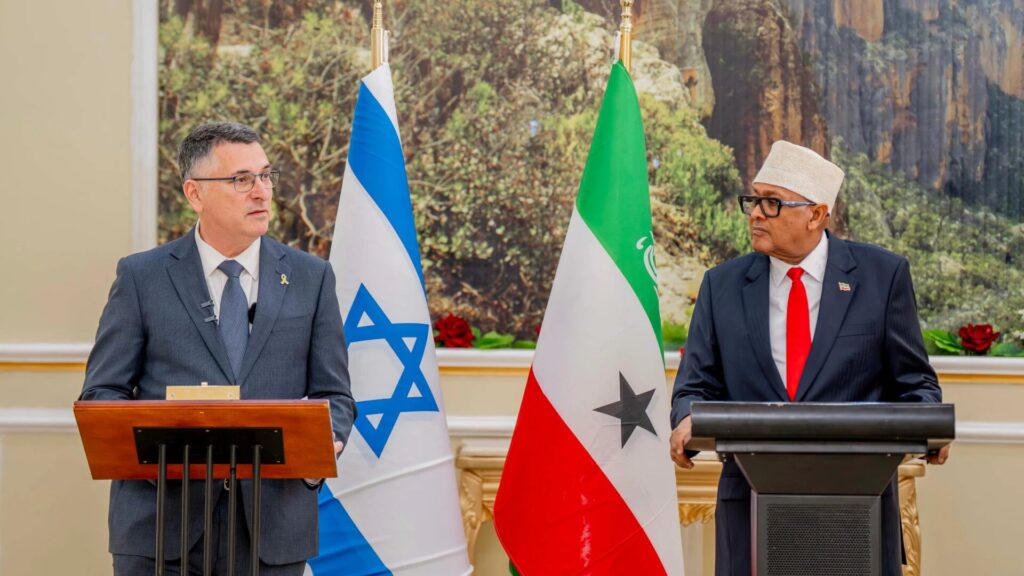
Israeli Foreign Minister Gideon Saar visited Somaliland on January 6, and held talks “on the full range of relations” with Somaliland’s president, Abdirahman Mohammed Abdullah, in the capital, Hargeisa. He said Israel would soon open an embassy and appoint an ambassador, despite broad international criticism over its decision to extend recognition to the territory, which most of the world considers part of Somalia.
“Nobody will determine for Israel who we recognize and who we maintain diplomatic relations with,” Saar said.
Israel’s strategic calculus
Israel’s decision can be seen as a way to push back against Houthi militants in Yemen, who have mounted hundreds of attacks against commercial shipping in the Bab el-Mandeb strait since the outbreak of the war in Gaza in October 2023. Having already degraded other Iran-backed militant groups like Hezbollah in Lebanon and Hamas in Gaza, Israel’s recognition of Somaliland increases its ability to target the operational infrastructure sustaining the Houthis, including their weapons-smuggling pipeline through Somali ports. There has also been unconfirmed speculation that Somaliland is being considered as a destination to resettle Palestinians forced out of Gaza.
As the first nation to end Somaliland’s 35 years of international diplomatic isolation, Israel is absorbing the full diplomatic cost of breaching the principle of border inviolability that was enshrined in the founding charter of the Organization of African Unity, the predecessor to the AU. It was intended to prevent a succession of secessionist movements from fragmenting the continent.
Israel’s decision could now prompt other states that might benefit from Somaliland’s statehood to follow suit.
The United Arab Emirates, which has developed closer ties with Israel in recent years and has substantial Red Sea investments, must now decide whether recognition would serve its strategic interests or would jeopardize its existing commercial and military access in Somalia. Landlocked Ethiopia, which has flirted with recognition of Somaliland in recent years as part of Prime Minister Abiy Ahmed’s desire to gain access to a Red Sea port, now has the diplomatic cover to do so without bearing the burden of being the first state to challenge the African Union’s consensus on territorial integrity.
What will the UN do?
Somalia ended 2025 in a paradoxical position: Elected to its first nonpermanent Security Council seat in half a century, it should have been in an ideal position to defend its interests during its two-year term, which will end in December. Instead, it finds itself grappling with an abundance of domestic constraints while facing another acute threat to its territorial integrity. There are also significant limits to what Somalia can accomplish on the Security Council, which is mired in severe deadlock. The number of resolutions it passed in 2024 was the lowest since 1991.
Nonetheless, Somalia have an elevated platform to make the diplomatic case for preserving its territorial integrity.
Five of the council’s 10 nonpermanent members were also replaced. Guyana, Algeria, and Sierra Leone, all of which supported Somalia’s position, rotated off, while Bahrain joined. This is notable because, unlike Algeria, Bahrain did not sign the joint Arab League statement condemning Israel’s recognition of Somaliland. As an original Abraham Accords signatory alongside the United Arab Emirates, which is not currently on the Security Council, Bahrain may thus be unlikely to support strong positions against Israeli actions.
All of this means the most likely scenario for Somalia’s final year on the Security Council is that the body will act more as a pressure valve for airing grievances than a venue for dispute resolution.
An unraveling order
It is likely that Netanyahu would make a personal appeal for the United States to join Israel to recognize Somaliland. U.S. President Donald Trump has profanely expressed his disdain for Somalia, so Netanyahu might effectively be pushing on an open door.
In fact, many Horn of Africa watchers already anticipated that Trump’s return to the White House would mean U.S. recognition of Somaliland. Project 2025, the Heritage Foundation’s blueprint for extreme right-wing governance that was released during Trump’s campaign, explicitly recommended that the next Republican administration recognize Somaliland as an insurance policy for America’s “deteriorating” position in Djibouti, the strategically located country near the Bab al-Mandeb that hosts both a U.S. and a Chinese military base. Yet despite this support from the Republican foreign-policy apparatus, Somaliland has not registered on the president’s radar. In fact, when asked by reporters to react to Israel’s decision, Trump quipped, “Does anyone know what Somaliland is, really?”
Here, the case of Sudan may prove instructive. Trump announced in November that the United States would make a renewed effort to resolve the conflict in Sudan, following a personal request from Saudi Crown Prince Mohammed bin Salman during his latest visit to Washington. There is a chance that Trump will change official U.S. policy toward Somaliland in the coming months, not because of a deliberate interagency process, but rather if Netanyahu asks him to.
Should that transpire, the implications will extend far beyond the Horn of Africa. U.S. recognition would consolidate a precedent in which great powers’ strategic interest – whether geopolitical rivalry with China, containment of Iran’s proxies, or resettling populations forcibly displaced by a key ally – determines other countries’ sovereignty, unity, and territorial integrity. This pathway to recognition drastically departs from the post-Cold War framework governing state creation, in which entities like Eritrea and South Sudan were able to achieve self-determination through a combination of military victory, negotiated agreements, and internationally monitored referenda.
Should additional countries follow Israel’s lead, the principle distinguishing Somaliland from unrecognized territories like Ambazonia in Cameroon, Biafra in Nigeria, and South Ossetia in Georgia becomes entirely opaque. Now that Somaliland has achieved recognition without meeting the conventional procedural threshold, the question ceases to be “why Somaliland?” and becomes “why not anywhere else?”